UGC for a mobile app on a small budget: what $0, $100 and $500 get you
Five ways to get UGC for an app when money is tight, from free founder videos to $13 real-creator clips, with the usage rights each leaves you and what $0, $100 and $500 buy.
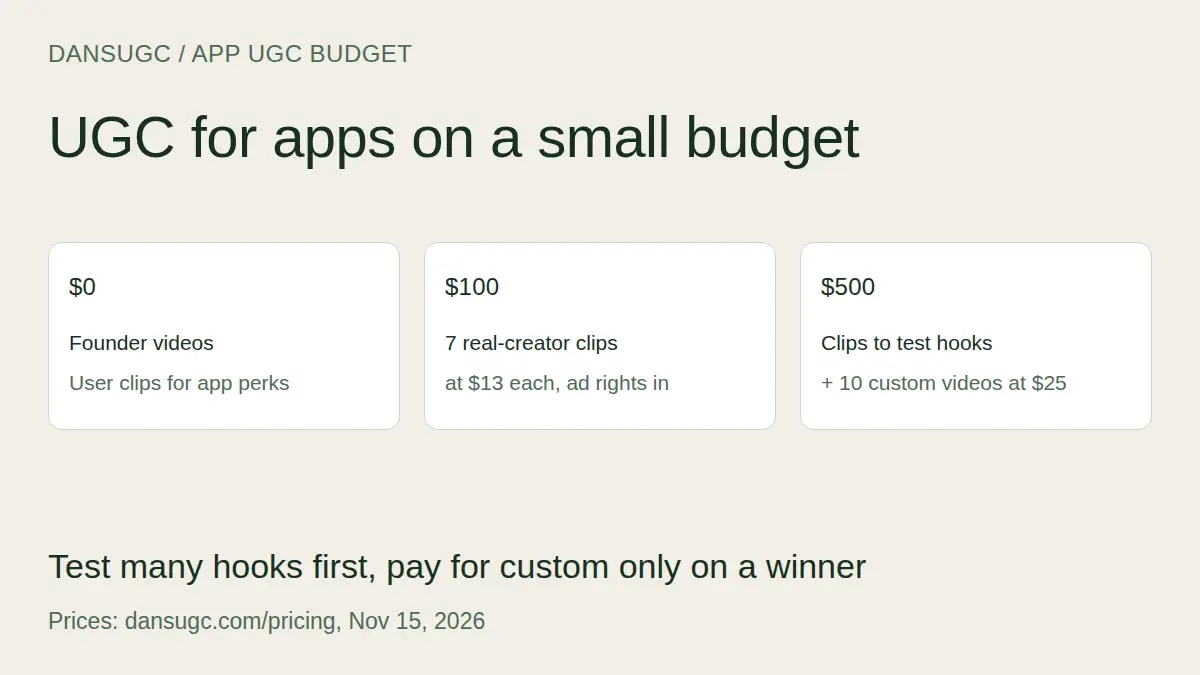
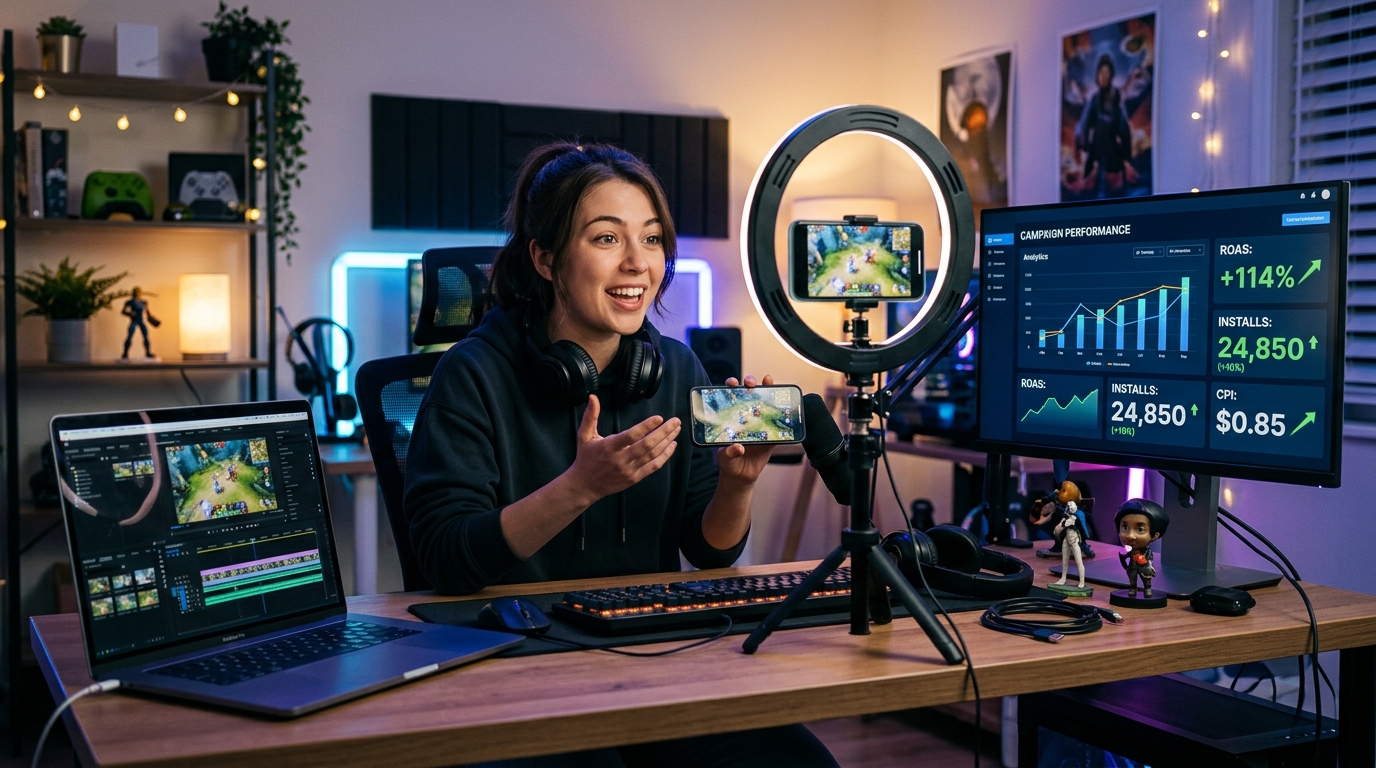
To get UGC for a mobile app on a small budget, start with the footage that costs nothing (your own users, your team, your App Store reviews), then spend your first $100–$300 on a handful of real-creator clips or two or three small creators, and only pay for custom videos once a hook has proven it can win. The trap isn't the price of a video; it's paying for content you can't legally run as an ad, or testing so few videos that you learn nothing.
Most guides that rank for this search give one route: hire cheap creators and brief them well. That works, but it skips two questions small app teams hit in week one: do you own the right to put that video behind ad spend, and how many videos do you actually need before a test tells you anything? This guide covers the five budget routes side by side, with real prices and the rights each one leaves you with.
What is the cheapest way to get UGC for a mobile app?
The cheapest way is free: ask your existing users for short videos in exchange for app perks, and film the founder or team yourself. The cheapest way to get ad-ready UGC from strangers is ready-made real-creator clips, which start at $13 each on DansUGC with no plan.
Here are the five routes, from free to paid:
- Your own users. Prompt happy users after a milestone (a finished workout, a saved budget, a high score) to send a 15-second video for a free month or a Pro unlock.
- Founder and team videos. "I built this app because I kept wasting time on X" filmed on a phone in your bedroom is still UGC-style content, and you own all of it.
- Product-for-content with nano creators. Small creators trade a short video for lifetime access plus a small fee.
- Paid micro creators. You pay per video or per view. Superapp's UGC playbook for apps (July 2026) puts small creators at $15–20 per video, students at $50–200 a month plus a bonus, and gives "$2 per 1,000 views" as an example of performance pay.
- Ready-made clips from a library. You license existing footage of real people reacting, talking or using their phone, and edit your app screens around it. On DansUGC a single clip is $13 without a plan and $9 on Pro.
How much does each route cost, and what do you get?
The comparison buyers actually need is cost, speed and rights, because a cheap video you can't run as an ad is worth nothing in paid growth.
| Route | Typical cost | Time to first video | Can you run it as a paid ad? | Best for | |---|---|---|---|---| | Your own users | Free (app perks) | Days to weeks, unpredictable | Only with written permission | Testimonials, organic posts | | Founder / team videos | Free | Today | Yes, you own it (disclose the connection) | Story-led hooks, early organic | | Nano creators, product-for-content | Free access + small fee | 1–2 weeks | Only if the agreement says so | Organic reach, first tests | | Paid micro creators | $15–20 per video, per Superapp | 1–2 weeks | Only if the agreement says so | Organic accounts, volume | | Ready-made real-creator clips | $13 per clip, or $9 on Pro (DansUGC) | Minutes | Yes, 12-month commercial license included (license) | Hooks and reactions for paid tests | | Custom UGC to your brief | From $25 per video, $250 minimum (DansUGC) | Days | Yes, under the order's license | Scaling a proven concept |
Ready-made clips won't show your app; they give you the human moment (the shocked face, the "wait, what?") that opens the ad, and you cut to your screen recording. If you need someone actually using your app on camera, you need a creator or a custom order. We wrote up that trade-off in UGC clips vs custom UGC.
What can you get for $0, $100 and $500?
A realistic plan by budget, using today's prices:
$0. Film three founder videos and three screen-recording edits over App Store reviews. Set up an in-app prompt asking users for a 15-second clip in exchange for a free month. You'll get organic posts and a few testimonials; expect most user videos to need a reshoot or a tight edit.
$100. Seven ready-made reaction clips at $13 each ($91) on the free DansUGC plan, or five to six videos from small creators at Superapp's $15–20 rate. Clips give you seven hooks today; creators give you fewer videos that show your app, a week or two later, with rights you have to negotiate.
$500. Mix both. Spend about $100 on clips to test hooks, then a $250 minimum custom order (ten videos at $25) built on whichever hook wins, and keep the rest for the ads themselves. Use the free UGC cost calculator to adjust the split to your volume.
Above roughly that level, a plan starts to pay off. DansUGC Pro is $291.58 a month billed yearly ($3,499), which lowers clips to $9 and unlocks ready-made packages at about $5 a clip. The 2026 DansUGC UGC Price Index found a median of $3.98 per clip across 60 DansUGC packages, against $25 for the cheapest custom video. That's not a small budget, so don't start there; it's where you go once you're buying clips every week.
For the budget maths behind higher volumes, see 100 UGC videos under $1,000 and UGC costs for app studios.
Do you need usage rights to run UGC as ads?
Yes. A video a creator posts on their own account is not automatically a video you can put behind ad spend from yours. Agree in writing which channels, how long, and whether the ad runs from your account or theirs, before anyone films.
This is where cheap routes get expensive. A product-for-content deal usually covers an organic post, not twelve months of Meta and TikTok ads. When a video wins, you're renegotiating with the creator from a weak position. Superapp's playbook lists "usage rights" in every creator brief for exactly this reason: "Once UGC works, you'll run it as paid ads."
Two other rules apply even when the video is free:
- Disclose the connection. The FTC's Endorsement Guides say that if an endorser has been paid or given something of value, or is an employee or relative of the company, that connection should be disclosed clearly. A free lifetime subscription counts as something of value.
- No invented experiences. An endorsement has to reflect the endorser's honest opinion, per the same FTC guidance. Don't script a user to claim results they didn't get.
Library clips sidestep the rights negotiation because the license is fixed up front. Every DansUGC purchase includes a 12-month commercial license, renewable or upgradable to perpetual, for organic posts and paid ads worldwide (license terms). Two limits to know: each purchase covers one brand, and running a clip as a Spark Ad from the creator's own account isn't included unless agreed in writing. Gambling and betting apps can't use the clips at all.
How many UGC videos do you need to test an app ad?
More than one, and the variable that matters is the number of hooks, not the number of polished videos. Plan for at least five to ten openings per concept so one weak first second doesn't kill a good idea.
The first second carries the ad. The 2026 DansUGC Hook Index found 73.5% of 1,249 high-performing TikTok hooks appear in the first frame of the video. And short footage is what advertisers actually buy: in the 2026 DansUGC Reaction Index, clips of 15 seconds or less took 94.4% of all licences, and the median library clip is 11 seconds.
That's why a small budget goes further on hooks than on full videos. One screen recording of your app, cut against seven different 2-second reaction openings, is seven tests. One custom video is one.
Judge the test on cost per install or trial, not views. RocketShip HQ's guide to UGC app ads (March 2026) suggests aiming for about 10 conversions a day per creative test, with 2 or 3 as the bare minimum when conversions are expensive. If your budget can't reach that, test fewer concepts at once rather than starving all of them.
Which UGC formats work best for app ads on a budget?
Reactions and problem-first openings, because they're cheap to produce and test quickly. Scripted testimonials cost the most to get right, and RevenueCat's look at UGC ads for apps (December 2025) argues they have become predictable, with value-first formats such as skits and pattern interrupts now converting better for subscription apps.
Our own sales data points the same way. In the 2026 DansUGC Reaction Index, a surprise-type reaction clip (surprised, shocked or amazed) was licensed 4.53 times on average versus 0.64 times for a neutral clip, across 7,480 labelled clips. Advertisers keep coming back for the "I can't believe this" face, not the calm explainer.
Three budget formats to start with:
- Reaction + screen recording. A real person's surprised reaction in the first second, cut to your app doing the thing. Browse reaction clips by emotion or the full real-creator clip library. Our storyboard for this format is in reaction video ads for apps.
- Founder story. "I built this because…" in the founder's own voice. Free, and it reads as a person, not an ad.
- Problem skit. The pain before your app, acted out in 10 seconds by a creator, then the fix on screen.
Creator-made ads tend to beat brand-made ones on the platforms app founders use most. TikTok's own analysis (November 2025) found creator ads drove a 70% higher click-through rate than non-creator ads at the same CPM.
Should you use AI UGC to save money?
You can use AI tools to rough out scripts and hook ideas, but be careful putting AI-generated people in your ads. In the Bentley University–Gallup survey (August 2026), 62% of US adults said it is unacceptable for businesses to use AI-generated people or voices in ads, even when disclosed.
For a small app, trust is the scarce thing, and a real face at $13 a clip doesn't need explaining. DansUGC sells real people only, never AI faces. If you're weighing the two, read our Arcads alternative breakdown.
A simple 2-week plan for a small app budget
- Day 1: Film three founder videos. Add an in-app video prompt for happy users.
- Day 2: License five to seven reaction clips that match your buyer's age and look.
- Days 2–3: Cut each clip onto the same screen recording. Write one on-screen line per hook.
- Days 3–10: Run them at a low daily budget, one concept, many hooks. Judge on cost per install or trial.
- Days 10–14: Take the top one or two hooks to a creator or a custom order, so the winning angle gets a version with someone using your app.
Repeat with a new concept once the winner fatigues.
FAQ
Where can I find cheap UGC creators for my app?
TikTok and Instagram search in your niche, Reddit and Facebook creator groups, and creator marketplaces. Superapp's playbook recommends Sideshift and lists those same search channels. Ask each creator's rate first and put usage rights in the agreement.
How much does UGC cost for a mobile app?
From free (users and founders) to $15–20 per video for small creators, per Superapp's playbook, to $9–$13 for a ready-made DansUGC clip and from $25 for a custom DansUGC video with a $250 minimum. See DansUGC pricing.
Can I make UGC for my app for free?
Yes. Film founder and team videos, and offer users perks for short clips. Disclose the connection when an employee, relative or rewarded user appears in an ad, per the FTC's Endorsement Guides.
How long should a UGC ad for an app be?
Short. In the 2026 DansUGC Reaction Index, clips of 15 seconds or less took 94.4% of licences. Get the hook into the first second and your app on screen soon after.
Is it better to buy UGC clips or hire creators?
Buy clips to test hooks fast with fixed rights; hire creators when you need someone using your app on camera. Most small teams do both: clips first, a creator for the winner.
Do I need to disclose UGC ads?
If the person was paid, given something of value, or is connected to your company, yes. Use the platform's paid-partnership or branded-content label where available.
Ready to get UGC videos for your brand?
Real human creators, 48-hour delivery, 12-month commercial license. Starting at $9/video.