UGC clips vs custom UGC: which should a brand buy?
Choose existing clips for suitable recorded moments, custom filming for your product or script, or a hybrid. Compare scope, editing, rights, and approved output.

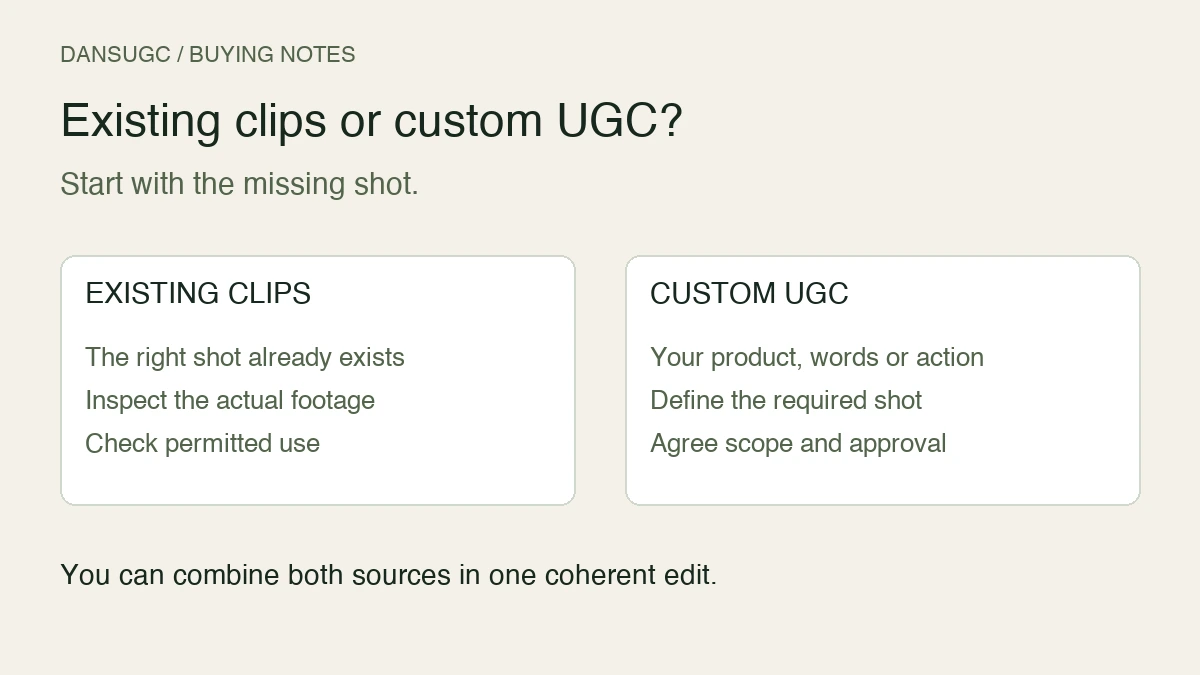
Buy existing UGC clips when the shot you need is already available and its permitted uses fit your project. Commission custom UGC when the creator must speak your script, handle your product, or perform a specific action. You can combine both: existing footage for supporting moments, custom footage for the parts that must be yours.
Start with the missing shot. Not the package size.
A surprised face can open an edit. It cannot demonstrate a feature it never shows. A custom shoot can solve that gap, but paying for one does not automatically mean the final video will work. These are sourcing choices, not performance guarantees.
The difference is control over what gets filmed
An existing clip is footage you can inspect before choosing it. You are selecting from what has already been recorded. Custom UGC starts with a brief and produces new footage for that scope. You have more opportunity to specify the action, words, setting, and product moment, but you also need a process for reviewing the result.
Do not confuse either option with a finished edit. A raw clip may still need captions, product footage, audio, and an ending. A custom order may cover only one recorded format. Ask what the deliverable includes instead of interpreting the word “video” as “ready to publish.”
DansUGC has separate entry points for the B-roll library and custom orders. Choose the source after you know the job. Use the UGC clips guide for the broader format and selection checklist.
Choose existing clips when the visual moment already fits
Existing footage is useful for a reaction opener, a transition, an everyday setting, or a supporting visual that does not require a new product-specific action. The advantage is that you can judge the actual take before building your edit around it.
Watch the whole clip. A strong first frame is not enough if the expression ends too early, the framing prevents your crop, or an unrelated object distracts from the message. Check that the movement connects naturally to the next shot. A clip that looks good alone may still be wrong for your sequence.
Before choosing it, answer three questions:
- Does this footage show the moment the script needs?
- Can I edit it into the intended output without creating a misleading impression?
- Does the license permit my intended use?
If any answer is unclear, resolve it before building the campaign or organic post around that asset. Access to a download does not answer every rights question. Check the actual terms for channels, duration, editing, and other intended uses.
Choose custom UGC when the missing moment is specific
Custom footage makes sense when a creator needs to say exact words, show your actual product, demonstrate a workflow, or perform a scene that the existing library does not contain. Write that missing moment into the brief before selecting a creator.
Be concrete. “Show the app” leaves too much to interpretation. “Record the current onboarding screen, complete the first action, and keep the screen readable” gives the reviewer something to check. Supply the current script and product references, and identify which elements must not change.
Also ask what you must provide. Does the creator need a shipped product, an account, a screen recording, or a supplied script? Who assembles the final edit? What happens if a required shot is missing? These questions affect the real scope even when the format name sounds familiar.
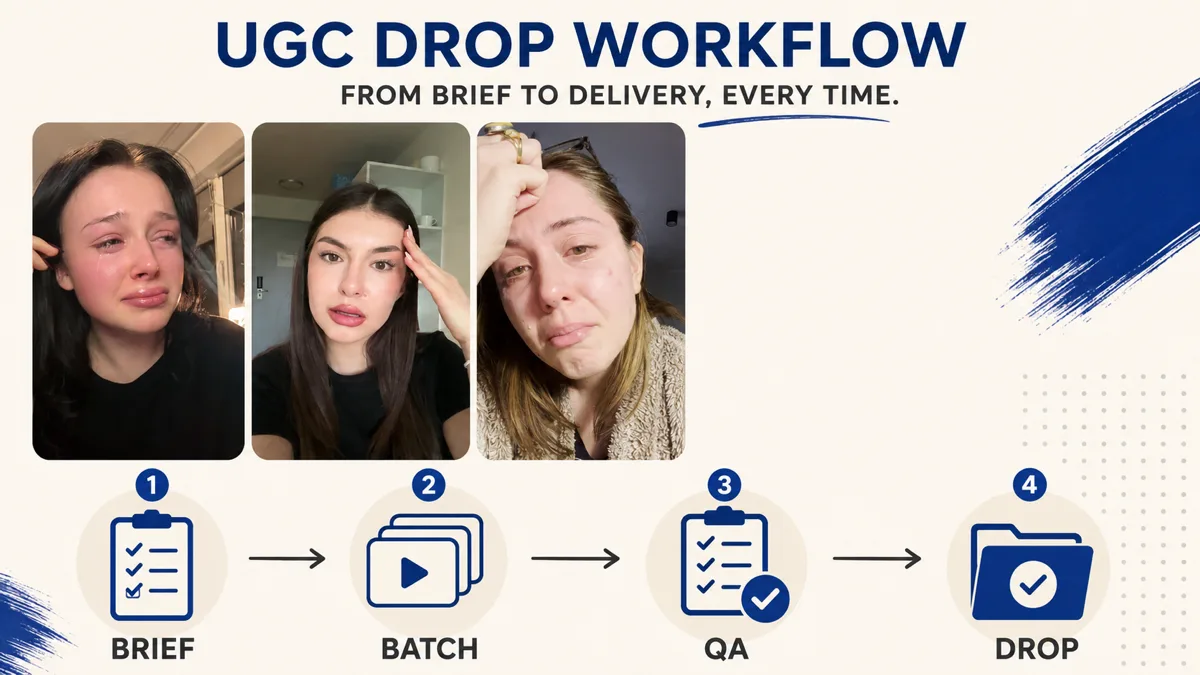
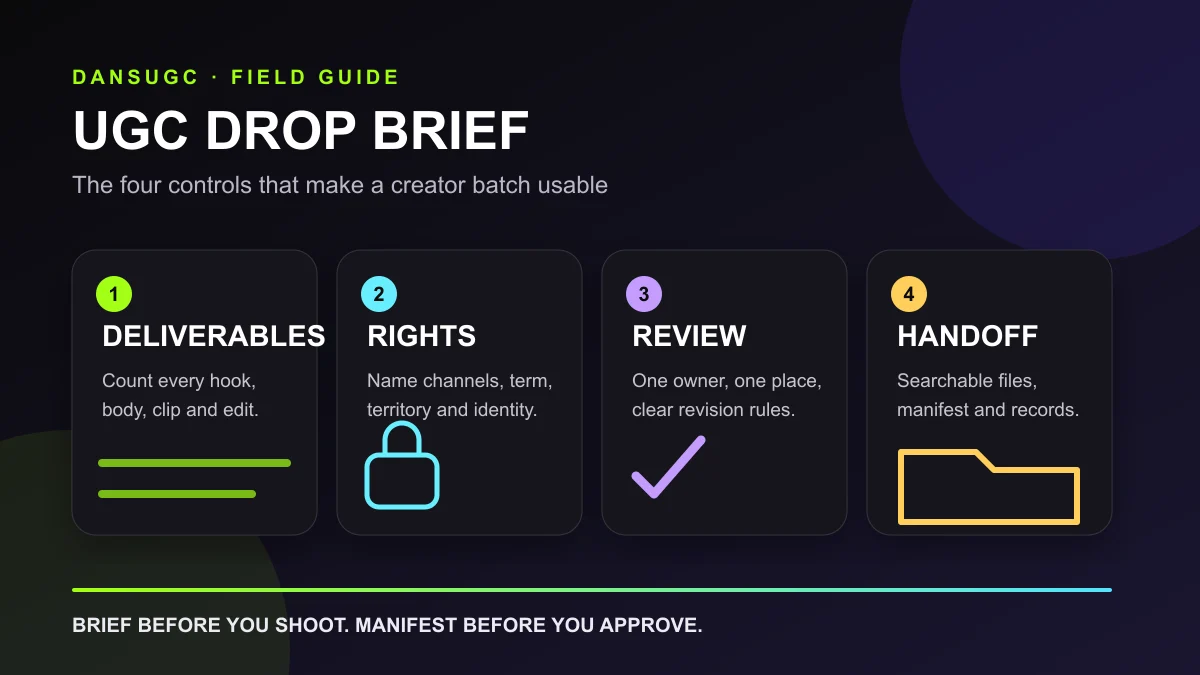
Use the UGC drop brief template to capture deliverables and approval requirements. A drop is a batch-delivery scope; it does not tell you whether every asset is existing, newly filmed, raw, or finished.
Use a hybrid approach when only part of the story needs filming
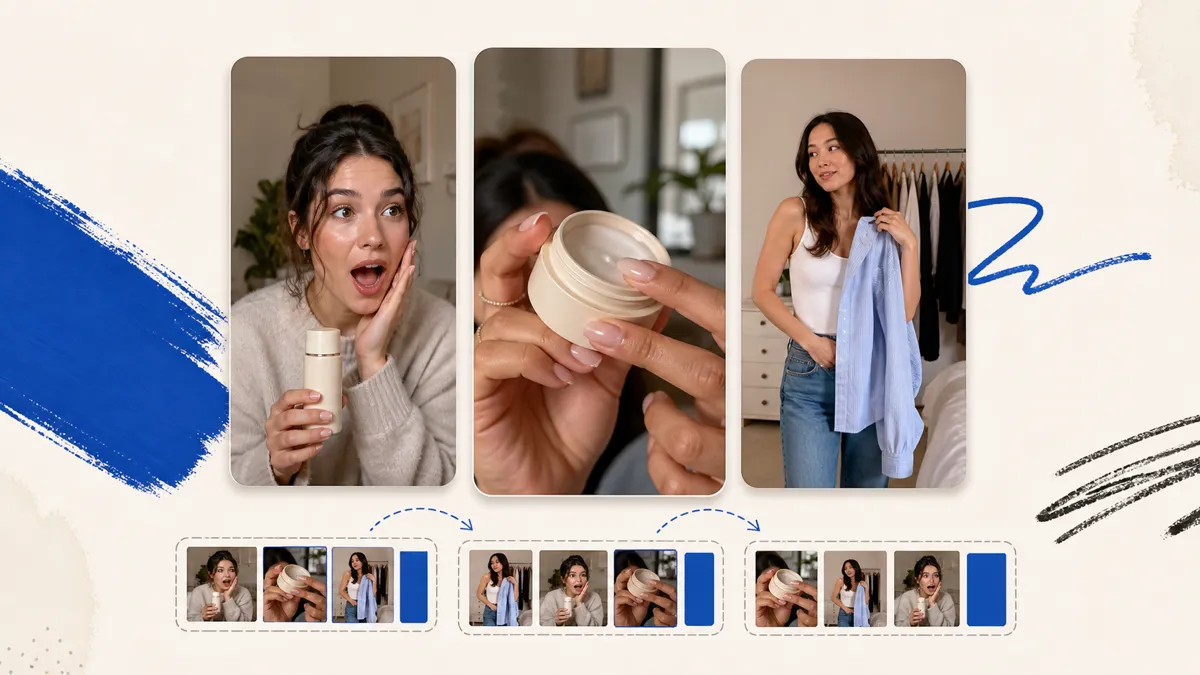
You do not have to buy every shot the same way. Consider a hypothetical app explainer: it needs an opening reaction, a demonstration of the app, and a closing line. Existing footage might fit the reaction. The demonstration must show the actual app. The closing line may require a creator to read a supplied script.
That is a planning example, not a DansUGC case study. Its purpose is to separate the jobs inside one video. Commission the missing product-specific material, then check whether the other moments can come from suitable existing assets.
Review continuity before committing. A change in person, lighting, or setting can be intentional, but it should not accidentally imply that two different people are the same customer. Captions and voiceover need to describe what the footage actually supports.
Compare the cost of approved output, not just the source file
The useful comparison includes everything needed to get an approved asset ready for its channel: sourcing or filming, editing, coordination, revisions, and any required usage permissions. A lower source-file price can still leave more work for your team. A higher filming quote can still exclude editing.
Ask both options the same questions. What exactly arrives? What is still missing? Who supplies it? What does approval require? Compare like-for-like scope before deciding which path is cheaper for your particular project.
Do not divide a bundle price by every possible export and call that the cost of a usable video. Count the exports that pass your requirements. Repeated crops or caption changes may be useful variants, but they are not automatically distinct ideas.
Test the source choice with one complete edit
Before scaling either path, take one asset through the whole process. Check the brief, rights, raw material, edit, approval, and destination. If your editor cannot complete that path, more footage will not fix the underlying gap.
For existing clips, the checkpoint is whether the selected footage really works in context. For custom footage, it is whether the delivered take meets the agreed brief. Keep those judgments separate from distribution results. An approved edit may still attract the wrong audience or present an offer people do not want.
The content-factory workflow explains how to keep those handoffs traceable. Record source IDs, the approved version, and the published destination so you can find the material again without guessing.
What not to assume
Neither route guarantees viral reach, sales, or a specific delivery time. Existing footage is not necessarily exclusive. Custom filming does not automatically include every usage right or revision you might later need. Confirm the actual agreement and current scope.
Do not present a staged reaction as a real customer's experience. If someone has not used your product, do not write their words as a personal result. Product claims and testimonials need their own evidence and review; choosing a real human creator does not make an unsupported claim accurate.
A quick decision checklist
- The exact shot exists, works in the edit, and its terms fit: consider an existing clip.
- The shot needs your product, script, or a specific original scene: brief custom footage.
- Only one part needs new filming: consider combining the two sources.
- You cannot define the required shot yet: fix the brief before buying either option.
Common questions
Are UGC clips the same as custom UGC?
Not in this buying comparison. Existing clips are selected from recorded footage. Custom UGC is newly filmed to an agreed brief. Either can be raw or edited, so confirm deliverables separately.
Is custom UGC always better?
No. It is better suited to a specific filming requirement. If the right existing shot already serves the message and its permitted use fits, commissioning a replacement may not solve any additional problem.
Can I combine library clips and custom footage?
Yes, provided the intended use is permitted and the finished sequence is accurate and coherent. Check the rights and how the people, product shots, captions, and voiceover relate to one another.
Where should I start?
Write a shot list, mark what you already have, and identify the gap. Browse the DansUGC library for suitable existing moments. Use the custom-order flow when the required action must be filmed to your brief. Buy the missing input, then evaluate the completed edit.
This guide is a buyer-side decision framework, not a pricing benchmark or performance study. Examples are hypothetical. Check the current product pages and terms before ordering.
Ready to get UGC videos for your brand?
Real human creators, 48-hour delivery, full commercial rights. Starting at $9/video.