Organic UGC vs paid UGC ads: choose the right workflow
Compare organic and paid UGC by distribution, total cost, evidence, and customer outcomes. Includes a sourced ProspectHalo example and a practical readiness checklist.

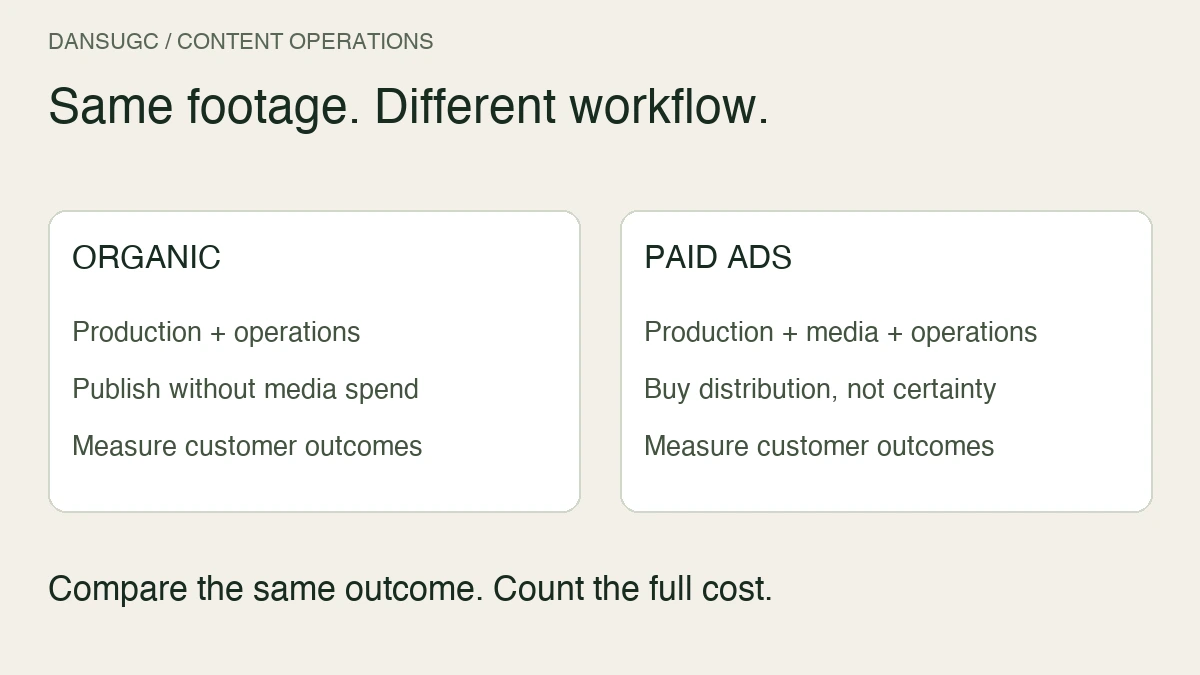
Organic UGC and paid UGC ads differ in how content reaches people, not simply whether a creator gets paid. A commissioned video can run on a brand account without an ad budget. The same footage can become an ad if its permissions cover that use and the brand pays for distribution.
The practical decision is which workflow your business can support: consistent organic publishing, a measured paid campaign, or neither until the offer and tracking work. Do not choose by comparing one viral post with one failed ad.
Start with the outcome you need. Then price the production, distribution, and measurement required to reach it.
First, separate the asset from its distribution
“Paid UGC” can mean paying someone to create a video. It can also mean running creator-style footage as an advertisement. Those are separate expenses.
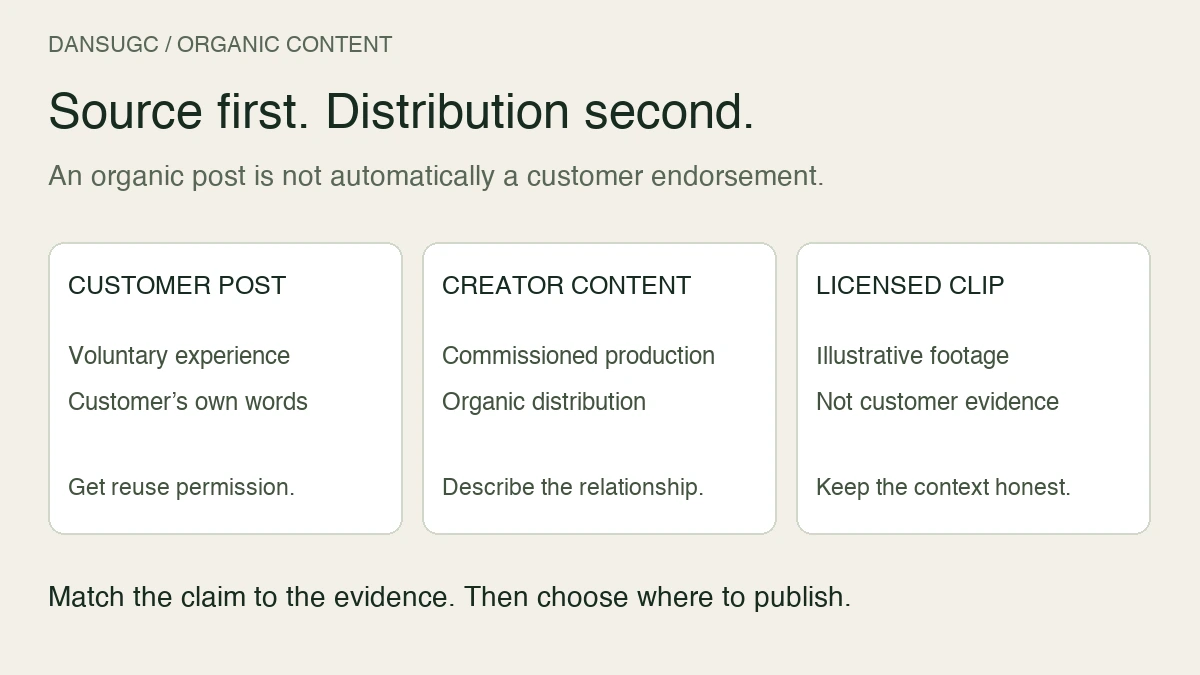
In this comparison, organic means distribution without buying ad placement. It does not mean every video is spontaneous customer feedback or costs nothing to produce. Our organic UGC guide explains the difference between voluntary customer posts, commissioned content, and licensed illustration.
A useful content record has two fields: where the footage came from, and where the finished edit will run. Without both, the budget and permissions conversation starts with the wrong assumptions.
Organic UGC vs paid UGC ads at a glance
Distribution and control
Organic: You publish through an account and earn whatever distribution the post receives. You can choose the subject, edit, account, and publishing schedule. You cannot promise a specific audience size or number of buyers.
Paid: You buy distribution through an advertising platform, subject to its delivery system and rules. You can set campaign parameters and spending limits, but spending is not a guarantee of profitable customers.
Cost structure
Organic: Count footage, editing, publishing, community work, tools, and the time spent reviewing results. No media invoice does not mean no acquisition cost.
Paid: Count the same relevant production work, plus media spend and campaign management. Separate the cost of making the asset from the cost of distributing it.
Creative job
Organic: A post can answer a question, demonstrate a feature, start a relevant conversation, or lead someone to the product. Decide which job it has before editing.
Paid: The creative needs to fit the campaign objective and destination. A compelling opening cannot repair an unclear subscription offer or broken checkout.
Success measure
Organic: Look beyond views to relevant responses, site visits, signups, activation, and customers where those outcomes can be measured.
Paid: Look beyond clicks to verified business outcomes and the cost of acquiring them. If the objective is a first paid subscription, do not call a free signup the same result.
Neither route is automatically better. The wrong comparison is cheap views against expensive purchases. Compare the same outcome over a clearly stated period.
When an organic-first workflow makes sense
Start with organic when you can demonstrate the product, keep publishing useful variations, and learn from the audience without needing predictable daily traffic.
That is a production commitment. Somebody still needs to select a question, capture evidence, edit the video, publish it, and handle the next step. A folder of reaction footage is not a distribution operation.
For an app founder, a workable unit can be a reaction-led opening followed by one actual product demonstration. The human footage introduces the situation. The screen recording explains the capability. The destination lets the interested viewer inspect or try it.
Use real UGC clip examples to assess whether footage fits your edit. Choose it for its role in the story, not because another company used a similar expression.
Organic is a poor fit for a plan that requires guaranteed traffic tomorrow. It is also a poor excuse to stop measuring what happens after a post gets attention.
What ProspectHalo's organic example actually shows
Our ProspectHalo case study documents a client using DansUGC reaction footage alongside product demonstrations in organic Instagram Reels. The founder's written account reports 7,978 signups over roughly 50 days.
The published case study keeps the source snapshots separate: the older funnel image shows 7,908 signups, while the Instagram Insights image uses a 60-day filter. Those are not identical reporting periods.
The founder also worked on the landing page, signup, onboarding, and paywall. That matters. The result is evidence of a complete workflow, not a controlled test proving reaction clips alone caused the signups.
The useful lesson is the division of work: reusable human footage, a real product demonstration, a clear next step, and attention to conversion after the click. It is not a forecast for another account, and it does not establish that organic outperforms paid ads.
When paid distribution is ready to test
A paid test becomes easier to interpret when the destination is usable, the offer is clear, the target outcome is defined, and measurement records that outcome reliably.
Before allocating media spend, answer these questions:
- What exact action counts as success: a qualified lead, a first purchase, or a first paid subscription?
- Can the tracking distinguish that action from free registrations, renewals, and test orders?
- Does the destination continue the promise in the creative?
- Is the footage cleared for the intended advertising use?
- Who reviews search or audience quality, creative performance, and the spending limit?
- What finding would make you stop, fix the offer, or continue testing?
If these answers are missing, buying more traffic can produce a larger bill without a clearer explanation. Fix the missing part before treating the channel as the problem.
This is a readiness checklist, not a recommendation to launch a particular ad platform or a claim that a specific budget is enough to find a winner.
Compare costs without pretending organic is free
Keep a simple cost sheet for each route. Use the same reporting window and say whether founder time is included. If the team uses one video in both channels, record a consistent allocation method rather than charging the entire production cost to each and then comparing totals.
Here is a hypothetical arithmetic example, not DansUGC or client performance:
- An organic programme costs $600 in production and operating time and has 12 attributed new customers. Recorded cost per attributed customer is $50.
- A paid programme costs $600 in production and management plus $900 in media, with 30 attributed new customers. Recorded cost per attributed customer is also $50.
The calculation is total recorded acquisition cost divided by attributed new customers. It is not proof that those customers would not have purchased without the content. Attribution and incremental impact are different questions.
If there are zero attributed customers, report the spend and zero customers. Do not report a $0 acquisition cost. If customer origin is unknown, show an unattributed bucket instead of assigning sales to the busiest channel.
Revenue quality matters too. One-off buyers, subscribers, refunds, and renewal revenue should not be collapsed into a single count without context. A view-to-signup story is not automatically a profitable acquisition story.
Can you reuse an organic video as an ad?
Sometimes. Treat it as a new publishing decision, not a copy-and-paste shortcut.
Check the creator or customer permission, footage license, music, edit rights, and any limits on channel, territory, or duration. Do not assume that permission for an organic post includes advertising use. Preserve the record with the asset using an asset-management workflow.
Then inspect the final message. A licensed reaction is not a testimonial from a customer who used the product. Changing the caption can change what the whole video implies.
For U.S.-facing endorsements, the FTC's disclosure guidance explains that relevant brand relationships must be disclosed clearly. Paying for production or giving something of value can matter even without paid distribution. Check applicable local and platform requirements for your specific use.
A post with strong organic views is a candidate to investigate, not a proven paid-acquisition asset. The audience, context, destination, and objective may differ. Keep the original organic result separate from any later paid result.
A decision you can make before buying more footage
Write down one audience question and one business outcome. Check whether the product demonstration and destination can support the promise. Then choose the constraint you are actually solving.
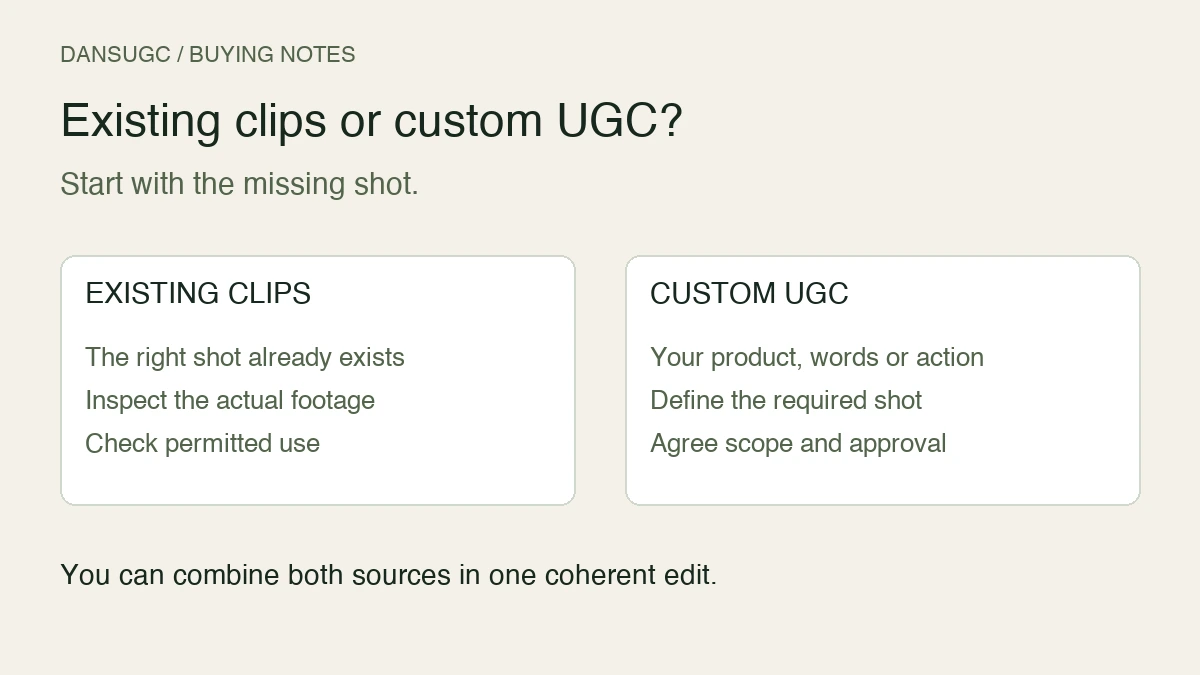
- If the missing piece is human footage for an existing demonstration, source the clip.
- If the missing piece is a product-specific explanation or genuine experience, create that evidence rather than adding a generic reaction.
- If the missing piece is distribution capacity, assign an owner and a realistic publishing process.
- If the missing piece is conversion measurement, fix it before declaring a channel profitable or unprofitable.
Build one coherent workflow first. Adding another channel does not remove the work required by the first one.
Frequently asked questions
Is paid creator content still organic if no ads run?
Its distribution can be organic, while its production is paid. Describe both accurately. Commissioned content should not be presented as spontaneous customer feedback.
Is organic UGC cheaper than paid UGC ads?
Not automatically. Organic avoids media spend but still consumes production and operating resources. Compare recorded costs against the same verified business outcome, with the same reporting window and attribution caveats.
Should you test every video organically before using it in ads?
No universal rule requires that workflow. Organic publishing can reveal audience questions and creative ideas, but its results do not guarantee paid performance. Choose the test based on what you need to learn and the permissions you have.
Can the same reaction clip support both routes?
Yes, if its license allows both uses and each finished edit is accurate. Keep separate post or campaign identifiers so you can distinguish the distribution and results.
Start with the missing asset, not a channel promise
If your demonstration is ready and you need supporting human footage, browse DansUGC's reaction and B-roll library. Check the current offer and license for the assets you select.
The clip can help you build the post. The offer, distribution, and customer journey still need to do their jobs.
This comparison is a recommended planning framework by Daniel Hangan, founder of DansUGC. The cost example is illustrative. ProspectHalo's results are attributed to its published case study, not presented as a channel benchmark or a guaranteed outcome.
Ready to get UGC videos for your brand?
Real human creators, 48-hour delivery, full commercial rights. Starting at $9/video.