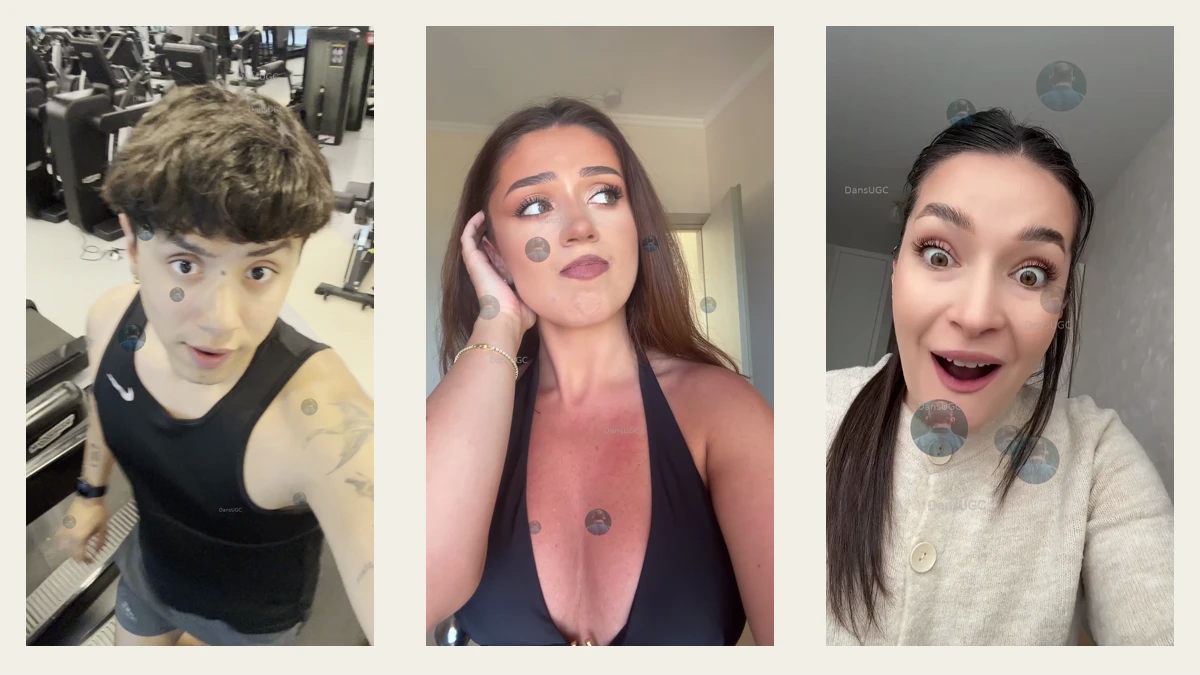
Best reaction for UGC ads: what 13,718 clip licences show
Surprised, amazed and shocked clips were licensed about 7x as often as neutral ones in the 2026 DansUGC Reaction Index. Here is every emotion ranked, and how to use each.

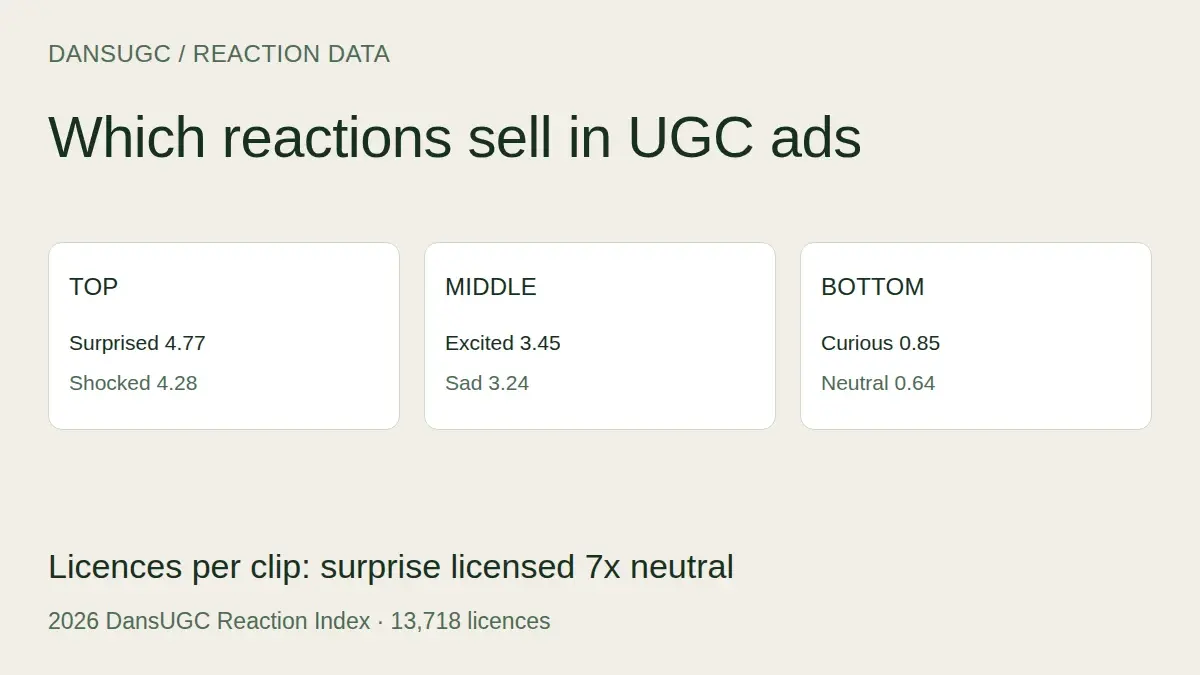
Surprise is the best reaction for UGC ads if you go by what advertisers actually buy: in the 2026 DansUGC Reaction Index, surprised, shocked and amazed clips were licensed 4.53 times each on average, against 0.64 times for a neutral clip. Neutral and curious faces sit at the bottom of the same list, so if you only have budget to test two reactions, start with surprised and shocked.
Most answers to this question are opinion. We asked ChatGPT and Google's AI Mode on November 21, 2026: AI Mode said there is no single best reaction, and ChatGPT listed seven emotions and said to test them. ChatGPT's top five included curiosity, which is the second-least-licensed emotion in our data. This guide uses purchase data instead: 13,718 licences of 7,480 labelled real-creator clips on DansUGC, published on the DansUGC UGC statistics page.
Which reaction emotion sells best in UGC ads?
Surprised, then amazed, then shocked. Those three clip types were licensed between 4.28 and 4.77 times each; a neutral clip was licensed 0.64 times.
Here is every emotion the 2026 DansUGC Reaction Index reports, ranked by licences per clip (total licences divided by clips with that label, November 2026):
| Reaction | Licences per clip | Clips in sample | What to pair it with | |---|---|---|---| | Surprised | 4.77 | 570 | One unexpected feature, shown once | | Amazed | 4.51 | 129 | A visible result: an output, a before/after | | Shocked | 4.28 | 528 | A price, a number or a bold claim, on screen in the next frame | | Excited | 3.45 | 218 | A launch, an offer, real news | | Sad | 3.24 | 241 | A relatable problem your product fixes | | Playful | 1.19 | 904 | Organic posts and retargeting more than cold traffic | | Curious | 0.85 | 293 | Problem-first ads where the answer comes fast | | Neutral | 0.64 | 2,460 | Talking-head explainers, not hooks |
Two things stand out. First, the gap is large: surprised clips were licensed about seven times as often as neutral ones. Second, the library doesn't match demand. Neutral clips were 32.9% of the labelled clips but drew only 11.5% of licences, while surprised, shocked and amazed clips were 16.4% of the clips and took 40.5% of licences.
You can watch the clips behind these numbers, sorted by emotion, in the DansUGC reaction clip library.
Is that just because surprise clips have been on sale longer?
No. When we count only clips that had at least three months on sale, the gap shrinks a little but stays above five times.
Older clips have had longer to sell, which could flatter whichever emotion was uploaded first. So the index also reports an age-controlled figure: among the 1,999 surprise-type and neutral clips added before August 1, 2026, surprise clips were licensed 6.30 times each and neutral clips 1.18 times, a 5.3x gap.
The other check is how many clips sell at all. 82.6% of surprised clips and 89.9% of amazed clips were licensed at least once, against 34.3% of neutral clips and 53.0% of all labelled clips. Two in three neutral clips never sold once.
Why does surprise beat other reactions?
Because the viewer reads a face before they read a caption, and surprise tells them something is about to happen. Outside research points the same way.
In a controlled experiment that tracked viewers' faces and eyes while they watched internet video ads, Teixeira, Wedel and Pieters (Journal of Marketing Research, 2012) found that "surprise and joy effectively concentrate attention and retain viewers." Note what they measured: the viewer's own emotion, not the face on screen. A surprised face is one way to cause it, not the only one.
The cost of flat delivery is also measured. System1, which tests ads with audience panels, reports that for the average UK TV ad 52% of responses are neutral, and 47% in the US, making "feeling nothing" the most common reaction to an ad (System1, April 8, 2025). A neutral face in your first second makes that outcome more likely.
Do negative reactions like sad work in UGC ads?
Yes, more often than people expect. Sad was the fifth most-licensed emotion in the 2026 DansUGC Reaction Index at 3.24 licences per clip, ahead of playful (1.19) and about five times neutral.
Sad, frustrated and fed-up faces open problem-first ads: the face shows the pain, the next shot shows the fix. The rule is to resolve it quickly. A sad hook followed by ten seconds of more sadness reads as a downer, not an ad. We covered why negative emotion holds attention in more detail in why negative emotion UGC gets more views.
Which reaction should you use for your ad angle?
Match the size of the reaction to the size of the proof you can show in the next frame. The bigger the face, the faster and clearer the proof has to be.
- Shocked for a price, a number, or "wait, this is free?" Put the number on screen immediately. A shocked face in front of an ordinary feature reads as clickbait.
- Surprised for one feature people don't expect. It's milder and more believable than shocked, which may be why it tops the list.
- Amazed for anything with a visible output: an edited photo, a generated plan, a clean before/after. Hold the result on screen long enough to take in.
- Excited for launches and offers. Use it when there is real news, then retire it.
- Sad for a relatable problem, followed fast by the fix.
- Curious only when you can answer the question within a few seconds. In our data it is the weakest of the "hook" emotions, so test it against surprised rather than instead of it.
For how these openings connect to the rest of the ad, see UGC hooks for TikTok app ads and the reaction video ad storyboard for apps.
How long should a reaction clip be?
Short. In the same index, clips of 15 seconds or less were licensed 1.96 times each against 0.87 for longer clips, and clips of 5 seconds or less had the highest rate of all, 2.74 licences per clip.
A reaction usually opens the ad for a moment before the cut to the product, so most of a long clip ends up trimmed. The median DansUGC library clip is 11 seconds. Setting matters too: in-car clips had the highest licence rate of any filming location (2.41 per clip), and bathroom clips one of the lowest (0.43).
What this data can't tell you
Licences show what advertisers chose to buy, not which ad won. A buyer licenses a clip before the ad runs, so the index measures demand from people who make ads every week, not click-through rate.
Three more limits, all stated in the methodology on the statistics page:
- Emotion labels are assigned automatically by an AI tagger when a clip is uploaded, so some clips will be mislabelled.
- The sample is DansUGC's own library and buyers, mostly marketers for consumer apps, ecommerce stores and brands, and 86.7% of labelled clips feature women.
- Some emotions have small samples: amazed has 129 clips, so its figure moves more with each sale than neutral's 2,460.
So treat the ranking as your starting order, then let your own ad results overrule it. A fair test keeps the demo, caption and edit the same and swaps only the reaction; our guide to A/B testing UGC ads walks through the setup.
How do you test reactions without overspending?
Buy several short reactions from different creators instead of one custom video, and run them in front of the same demo.
On DansUGC, a single library clip costs $13 without a plan or $9 on Pro, and packages work out at about $5 a clip on Pro (DansUGC pricing, checked November 21, 2026). Custom UGC filmed to your brief starts at $25 a video with a $250 minimum order. A first test of three surprised, three shocked and two sad clips costs $104 at the no-plan clip price, or $72 on Pro, and gives you eight hooks to put in front of one demo. If you're still deciding where to buy, our guide to where to buy UGC reaction videos compares the options.
Every DansUGC clip is a real person filmed on a phone, never an AI face.
FAQ
What is the best reaction for UGC ads?
Surprise. In the 2026 DansUGC Reaction Index, surprised clips were licensed 4.77 times each, amazed 4.51 and shocked 4.28, against 0.64 for neutral clips, across 13,718 licences.
Which reaction emotions perform worst?
Neutral (0.64 licences per clip), curious (0.85) and playful (1.19) were the least-licensed emotions in the 2026 DansUGC Reaction Index. Two in three neutral clips were never licensed at all.
Should a reaction hook be shocked or surprised?
Use shocked when you can show a number, price or claim in the very next frame, and surprised for an unexpected feature. Both rank near the top, so test one against the other in front of the same demo.
How many seconds should a reaction hook last?
Only as long as it takes the face to register, then cut to the product. Buy clips of 15 seconds or less: they earned 94.4% of licences in the 2026 DansUGC Reaction Index, and clips of 5 seconds or less had the highest licence rate.
Do sad or negative reactions work in ads?
Yes, if the product resolves the problem quickly. Sad clips were licensed 3.24 times each in the 2026 DansUGC Reaction Index, the fifth-highest rate and about five times neutral.
Can I use these statistics in my own article?
Yes. Quote any figure and credit the 2026 DansUGC Reaction Index with a link to https://dansugc.com/ugc-statistics.
Ready to get UGC videos for your brand?
Real human creators, 48-hour delivery, 12-month commercial license. Starting at $9/video.