How to A/B Test UGC Ads: The 5 Variables That Actually Move the Needle
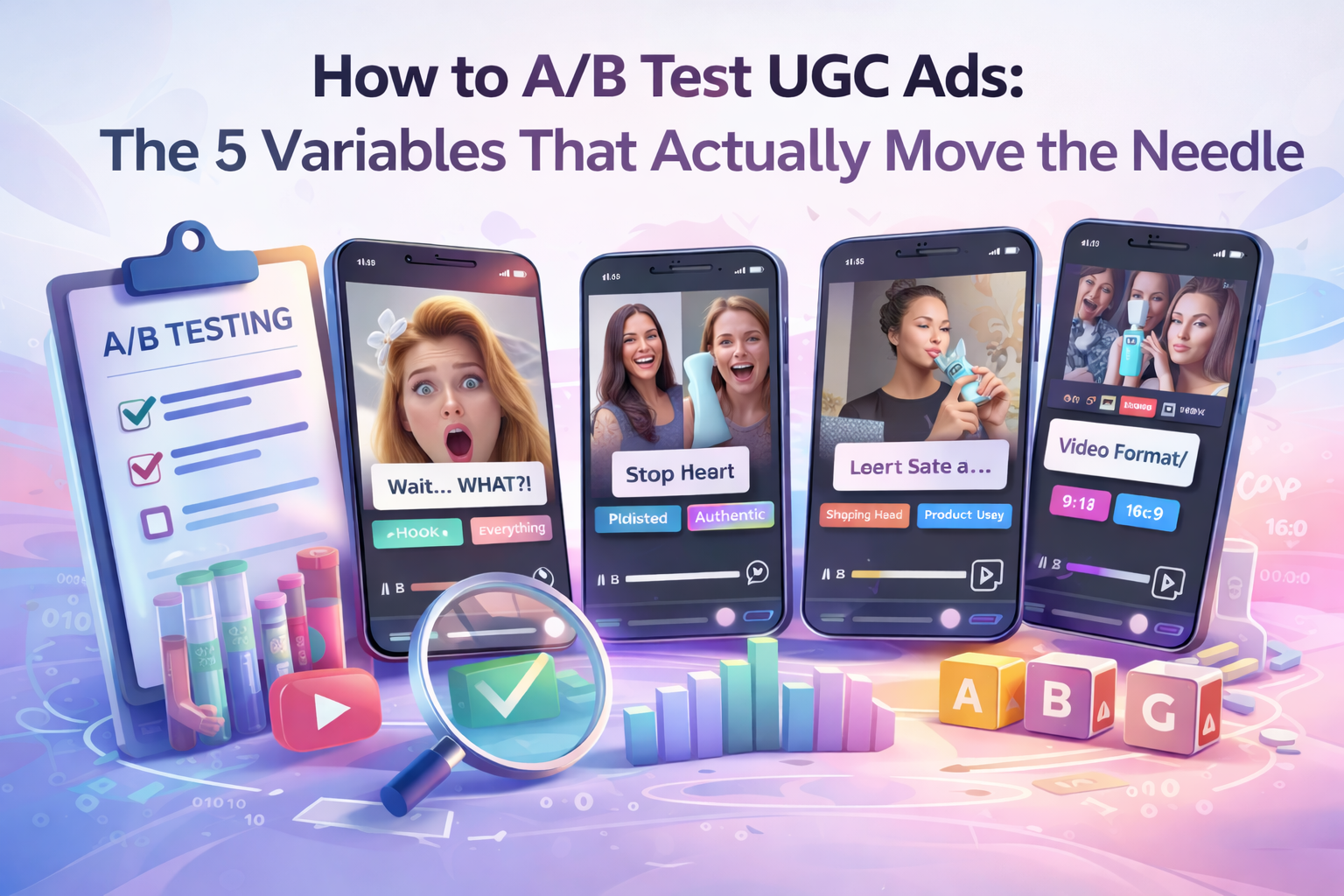
The Problem: Most brands test UGC ads randomly, changing multiple variables simultaneously and never knowing what actually drove performance differences. They burn through the budget without gaining actionable insights. The Reality: Only 5 variables consistently move the needle in UGC ad performance: the hook (first 3 seconds), the creator's authenticity level, the product demonstration approach, the call-to-action specificity, and the video format/orientation. Everything else is noise.

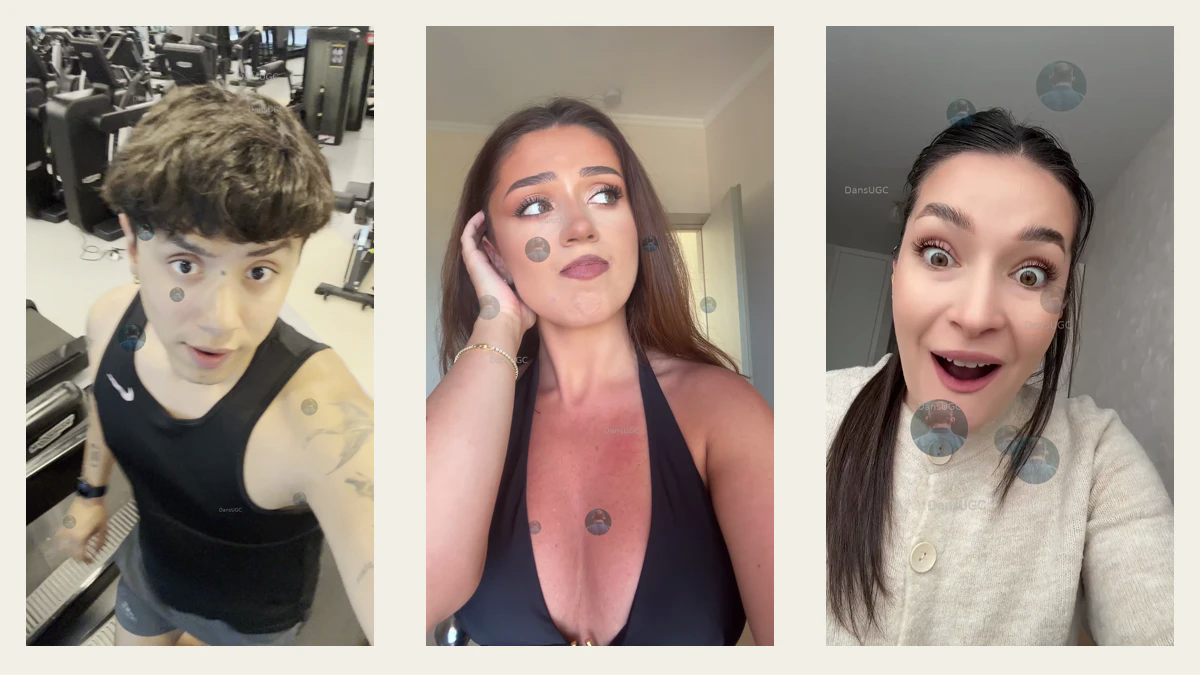
You've invested in UGC content. You've got 20 videos from real customers showing your product. Now you need to figure out which ones actually drive conversions so you can scale the winners and kill the losers.
Most brands approach this by throwing all 20 videos into ad campaigns, letting them run for a week, and seeing which ones "perform best." This approach wastes 60-80% of your testing budget because you're generating noise, not insights.
Real testing isn't about creating lots of content and hoping something works. It's about systematic experimentation that isolates variables, reaches statistical significance, and produces repeatable insights you can apply across all future content.
I've managed over $8M in UGC ad spend across 47 different brands, and I can tell you exactly which variables actually move performance and how to test them properly. Let me show you the framework that consistently identifies winning ads in 3-5 days instead of the weeks or months most brands waste on inconclusive testing.
Why Most UGC Testing Fails (And Wastes Your Budget)
Before we dive into what works, let's understand why most UGC testing produces useless results.
The Multivariate Chaos Problem
Brand creates 10 UGC videos. Each video has a different creator, different hook, different demonstration style, different length, different CTA, and different background setting. They launch all 10 simultaneously, let them run for a week, and declare video #7 the winner because it had the lowest cost per conversion.
What did they learn? Absolutely nothing actionable.
They don't know if video #7 won because of the creator, the hook, the demonstration style, or pure random chance. They can't replicate the winning elements in future content because they don't know which elements actually mattered.
This is multivariate chaos. Too many variables changing simultaneously. No control group. No statistical rigor. Just expensive guessing disguised as testing.
The Sample Size Delusion
A brand runs two UGC ads for three days. Ad A gets 8 conversions at $12 each. Ad B gets 12 conversions at $15 each. They declare Ad A the winner and kill Ad B.
This decision is almost certainly wrong.
With only 8-12 conversions per variant, you're looking at random noise, not meaningful performance differences. Statistical significance requires much larger sample sizes. These brands are making permanent decisions based on temporary fluctuations.
The Impatience Trap
Testing feels slow. You want answers now. So you look at preliminary data after 24 hours and make decisions.
This is how you kill winning ads before they prove themselves. Performance in the first day rarely predicts performance over weeks. Platform algorithms need time to optimize delivery. Audience mix varies by day of week.
Impatience creates false conclusions that compound into systematically poor decision-making.
The 5 Variables That Actually Move the Needle
After testing thousands of UGC ads, performance variance comes down to five core variables. Everything else is secondary noise that doesn't materially impact results.
Variable 1: The Hook (First 3 Seconds)
The hook accounts for 60-70% of performance variance in UGC ads. This is the single most important element to test systematically.
Your hook determines whether viewers stop scrolling and watch your ad or keep scrolling past it. On platforms like Facebook, Instagram, and TikTok, you have approximately 1-3 seconds to capture attention before users scroll away.
A strong hook can make mediocre body content perform well. A weak hook dooms even excellent content because nobody watches long enough to see it.
What Makes a Hook Actually Work
Effective hooks fall into five categories, each working through different psychological mechanisms:
Pattern interrupts break expected scrolling patterns. Examples: sudden movement, unusual angles, surprising visual elements, or people doing unexpected things. A creator dropping a product, something breaking, or dramatic before/after reveals all interrupt the pattern.
Direct address hooks speak directly to specific viewer pain points or desires in the first sentence. "If you're tired of [specific problem]" or "This changed how I [specific outcome]" or "I didn't believe this until I tried it myself."
Social proof hooks lead with credibility signals. "After testing 47 different [product category]" or "My dermatologist recommended this" or "This has 4,000 five-star reviews for a reason."
Curiosity gaps create questions the viewer wants answered. "This $12 thing replaced my $300 [alternative]" or "I wish I'd known this before spending $500 on [competitor]." The viewer keeps watching to find out what the thing is.
Problem agitation intensifies a problem the viewer already has. "Your [product category] is probably damaging your [thing they care about] and you don't even know it." This works when the problem is genuine and the agitation is specific.
How to Test Hooks Systematically
Create 3-5 videos that are identical except for the first 3 seconds. Same creator, same demonstration, same CTA, same length. Only the hook changes.
This isolated variable testing tells you exactly which hook type resonates with your audience. The winning hook approach can then be applied across all future content with that creator or similar creators.
Run these variants simultaneously with equal budget distribution. Measure hook rate (3-second video views / impressions) as your primary diagnostic metric and cost per conversion as your ultimate decision metric.
Reach minimum 100 conversions per variant before declaring a winner. At lower volumes, you're likely seeing statistical noise rather than meaningful differences.
When you identify a winning hook approach, create 5-10 additional variations using that same hook structure but with different specific wording or visuals. This second-level testing optimizes within the winning category.
Variable 2: Creator Authenticity Level
Not all UGC creators are equally authentic, and authenticity level dramatically impacts performance. This variable is often overlooked because it's less obvious than hooks or CTAs.
Creator authenticity exists on a spectrum from "obviously following a script" to "genuinely sharing personal experience." Where your creator falls on this spectrum affects trust, engagement, and conversion.
The Authenticity Spectrum
Level 1: Script followers deliver your messaging word-for-word with minimal personal voice. They're clearly reading or reciting. Performance is typically weak because viewers immediately recognize this as branded content disguised as UGC.
Level 2: Structured storytellers follow a general structure you provide but use their own words and personal details. They hit your key points but in their authentic voice. Performance improves significantly because the content feels more genuine while still delivering your core message.
Level 3: Genuine advocates create content based on their actual experience with minimal guidance from you. They might not hit all your talking points, but what they do say feels completely authentic. This typically delivers the strongest performance because trust is highest.
Testing Creator Authenticity
This variable is harder to test because you can't easily control it with the same creator. Instead, you test across different creators who naturally fall at different authenticity levels.
Create content with three different creators: one highly scripted, one moderately guided, and one minimally directed. Keep everything else consistent: similar hooks, similar demonstration approaches, similar length.
Run these simultaneously and measure both engagement metrics (hook rate, completion rate) and conversion metrics (CTR, conversion rate, cost per conversion).
You'll often find that moderately guided creators deliver the best performance. Highly scripted feels inauthentic. Completely unguided sometimes misses key selling points. The middle ground balances authenticity with message control.
Once you identify your optimal authenticity level, brief all future creators at that level of structure versus freedom.
Variable 3: Product Demonstration Approach
How the creator demonstrates or discusses your product significantly impacts conversion rates. This variable has four primary approaches worth testing.
Demonstration Approach Types
Unboxing/first impression shows the creator receiving and opening the product for the first time. Genuine first reactions create curiosity and authenticity. Works best for products with impressive packaging or surprising features.
In-use demonstration shows the product being used in realistic scenarios. The creator demonstrates actual functionality, showing viewers exactly what they'd experience. Works best for products where seeing it in action creates desire.
Before/after showcase emphasizes the transformation or result the product delivers. This can be immediate (cleaning products) or over time (skincare, fitness). Works best when results are visually dramatic.
Comparison positioning compares your product to alternatives the viewer likely knows or uses. "I switched from [familiar alternative] to this and here's why" gives context and justification. Works best in crowded categories where differentiation matters.
How to Test Demonstration Approaches
Create 4 videos with the same creator using the same hook but different demonstration approaches. Keep length similar and use the same CTA. The only variable is how the creator shows or discusses the product.
Run simultaneously with equal budgets. Track full-funnel metrics because different approaches impact different funnel stages. Unboxing might drive high initial engagement but lower conversion. Comparison might drive lower engagement but higher conversion.
The winner depends on your product category, price point, and purchase consideration length. Testing reveals which approach works for your specific situation rather than following generic best practices.
Variable 4: Call-to-Action Specificity
The CTA is the second most impactful variable after the hook, yet most brands use generic CTAs without testing alternatives. CTA specificity and positioning dramatically affect conversion rates.
CTA Types by Specificity Level
Generic CTAs use standard language: "Shop now," "Learn more," "Check it out." These work adequately but rarely optimize conversion because they don't create urgency or specific motivation.
Outcome-focused CTAs emphasize the benefit: "Get yours before they sell out," "Start your free trial," "See the difference yourself." These perform better by connecting the action to a desirable outcome.
Objection-handling CTAs address specific hesitations: "Try it risk-free for 30 days," "Free shipping both ways," "Cancel anytime, no questions asked." These work exceptionally well when a specific objection prevents conversion.
Urgency-creating CTAs add time or scarcity pressure: "25% off ends tonight," "Limited stock available," "Join 10,000+ customers." These drive immediate action but must be genuine to avoid damaging trust.
Testing CTA Variations
Create 3-4 videos that are identical except for the final 5-10 seconds where the CTA appears. Same hook, same creator, same demonstration. Only the CTA changes.
Test both the wording and the timing. Some products convert better with early CTAs (around the 15-second mark) while others need the full demonstration before the CTA (final 5 seconds of a 30-second video).
Measure click-through rate and conversion rate separately. A CTA might drive high CTR but low conversion if it attracts clicks from less-qualified viewers. Optimize for cost per conversion, not clicks.
Variable 5: Video Format and Orientation
Format includes length (15s, 30s, 60s+) and orientation (vertical, square, horizontal). This variable interacts with platform and placement, making it critical to test for your specific context.
Format Performance Patterns
Short-form (15-20 seconds) maximizes completion rates and works well for simple products or strong immediate hooks. Testing shows these often deliver lowest cost per click but sometimes struggle with conversion because there's insufficient time to build desire or handle objections.
Mid-form (25-35 seconds) balances completion with substantive content. This is the sweet spot for most products, providing enough time for hook, demonstration, and CTA without losing viewer attention.
Long-form (45-90 seconds) allows comprehensive storytelling and objection handling. Performance varies dramatically by product complexity and price point. High-consideration purchases often benefit from longer content while impulse purchases perform better with brevity.
Orientation Considerations
Vertical (9:16) is native to mobile feeds on TikTok, Instagram Reels, and Facebook Stories. Generally delivers best performance on these placements because it feels native and uses full screen real estate.
Square (1:1) works across placements without optimization, making it practical for multi-platform campaigns. Performance is good but rarely optimal because it compromises on every platform rather than excelling on any.
Horizontal (16:9) performs poorly in mobile feeds but better in desktop placements and YouTube. Use this only if your audience is primarily desktop or your product demonstration requires wider framing.
Testing Format Variables
Test length and orientation separately, not simultaneously. Start with length testing: create three versions of the same content at 20, 30, and 45 seconds. Trim content progressively, don't just cut arbitrary sections.
Run these with equal budgets across your primary placement. Measure completion rate, CTR, and conversion rate. You'll often find that mid-length versions deliver the best balance of engagement and conversion.
Once you've identified optimal length, test orientation if you're running cross-platform. Create the winning length in vertical, square, and horizontal formats and test performance across placements.
The Testing Framework: From Chaos to System
Knowing which variables to test is useless without a systematic framework for actually running tests that produce actionable insights. Here's the exact process that consistently identifies winners.
Step 1: Establish a Control
Before testing anything, you need a baseline control ad. This is your current best-performing UGC ad, or if you're just starting, your first properly produced UGC piece.
The control runs continuously throughout your testing. All challenger ads are measured against the control's performance, not against each other. This prevents false conclusions when overall campaign performance fluctuates due to external factors.
Allocate 40% of your testing budget to the control and 60% to challengers. This ensures the control generates sufficient conversion volume for reliable comparison while giving challengers enough budget to prove themselves.
Step 2: Choose ONE Variable to Test
Select exactly one variable from the five core variables. Create 2-3 challengers that differ only in that variable while keeping everything else identical to the control.
If testing hooks, use the same creator, demonstration, CTA, and format as the control. Only change the first 3 seconds.
If testing creator authenticity, keep the same hook structure, demonstration approach, CTA, and format. Only change the creator and their level of scripting.
Resist the temptation to change multiple variables simultaneously. That creates multivariate chaos where you can't determine what drove performance differences.
Step 3: Calculate Required Sample Size
Before launching tests, determine how many conversions you need to reach statistical significance. Use this formula as a starting point:
For 95% confidence level, you need minimum 100 conversions per variant to detect a 20% performance difference. If you expect smaller performance differences, you need larger sample sizes.
Use online statistical significance calculators to determine exact sample sizes for your expected performance lift and desired confidence level.
If your budget can't generate 100+ conversions per variant within 7 days, you're testing beyond your means. Either increase budget or test sequentially instead of simultaneously.
Step 4: Launch with Equal Budget Distribution
Set up your test campaign with the control receiving 40% of budget and each challenger receiving equal portions of the remaining 60%.
With one challenger, that's 40% control / 60% challenger. With two challengers, that's 40% control / 30% challenger A / 30% challenger B. With three challengers, that's 40% control / 20% each challenger.
Don't let platform algorithms automatically optimize budget distribution during the test. You need equal exposure to compare performance fairly.
Step 5: Let Tests Run to Statistical Significance
Monitor performance daily but don't make decisions until you reach your predetermined sample size. Track these metrics in order of importance:
Primary metric: Cost per conversion (this determines winners) Secondary metrics: Hook rate, CTR, landing page conversion rate (these diagnose why winners win) Tertiary metrics: Engagement, comments, shares (interesting but not decision-driving)
Use statistical significance calculators to confirm when performance differences are real versus random variance. Most tests require 3-7 days to reach significance, but let conversion volume, not calendar days, determine when you make decisions.
Step 6: Analyze, Scale, and Iterate
Once you reach statistical significance, analyze both the primary metric and diagnostic metrics to understand what made the winner successful.
If a challenger beats the control by 20%+ with statistical significance, it becomes your new control. Scale its budget and use it as the baseline for the next round of testing.
If no challenger beats the control, you've learned that variable doesn't significantly impact performance for your specific context. Move on to testing a different variable.
Document everything. Create a testing log that records which variables you've tested, what you learned, and which approaches won. This institutional knowledge becomes invaluable over time.
Step 7: Move to the Next Variable
After completing one test cycle, select the next highest-impact variable to test. The testing priority order is:
- Hook (if not yet tested)
- Creator authenticity (if not yet tested)
- Demonstration approach (if not yet tested)
- CTA specificity (if not yet tested)
- Format/length (if not yet tested)
- Return to hook testing with new variations based on initial learnings
This creates a continuous optimization cycle where each test builds on previous learnings, compounding improvements over time.
Common Testing Mistakes That Waste Budget
Even with the right framework, specific execution mistakes can invalidate your testing results. Watch out for these common pitfalls.
Mistake 1: Testing During Platform Learning Phases
When you launch new campaigns or make significant changes, advertising platforms enter a "learning phase" where performance is unstable. Facebook typically needs 50 conversions to exit learning. Google needs 30-50.
Don't run A/B tests during learning phases. Results will be volatile and unreliable. Wait until campaigns stabilize, then begin systematic testing.
Mistake 2: Changing Tests Mid-Flight
You launch a test comparing three hooks. After two days, you notice one performing poorly and pause it to "save budget." You've just invalidated your test.
Stopping tests early creates selection bias. Maybe the "poor performer" would have improved as the algorithm optimized. Maybe day-of-week variance was affecting results. You'll never know because you didn't let it reach statistical significance.
Commit to running tests to completion unless something is catastrophically broken (10x worse than control, clearly technical issue, etc.).
Mistake 3: Testing Too Many Variables Simultaneously
Testing is not "run 10 different videos and see what happens." That's random content deployment, not systematic testing.
Limit yourself to testing one variable at a time with 2-3 variants maximum. This constraint forces prioritization and produces clear learnings.
The only exception is if you have massive traffic volume where true multivariate testing is statistically viable (typically 1,000+ conversions per week). Most businesses don't have this luxury.
Mistake 4: Ignoring Statistical Significance
Two ads have run for 5 days. Ad A generated 23 conversions at $8.20 each. Ad B generated 27 conversions at $7.85 each. You declare Ad B the winner.
This is almost certainly a false conclusion. With sample sizes this small, the performance difference is likely random variance, not meaningful superiority.
Use statistical significance calculators before declaring winners. Accept that sometimes tests are "inconclusive" because neither variant proved definitively better. That's valuable information too.
Mistake 5: Testing Without Hypotheses
Random testing wastes budget. Before each test, form a specific hypothesis about what you expect to happen and why.
"Hypothesis: Direct address hooks will outperform curiosity gap hooks because our audience is problem-aware and needs immediate relevance, not intrigue."
When results come in, you're not just identifying winners. You're validating or invalidating hypotheses, which builds strategic understanding that informs future content creation.
Advanced Testing: When to Go Beyond the Basics
Once you've systematically tested all five core variables and have solid baseline performance, you can explore more sophisticated testing approaches.
Sequential Testing for Budget-Constrained Brands
If your budget can't support simultaneous A/B testing with statistical significance, use sequential testing instead.
Run Ad A for one week, record performance metrics. Run Ad B for the following week with identical budget, targeting, and placements. Compare results accounting for any major external changes (seasonality, promotions, market events).
This is less scientifically rigorous because you can't control for temporal variance, but it's more practical than running underpowered simultaneous tests that never reach significance.
Cohort Testing for Audience Segmentation
Once you identify winning overall ads, test whether different audience segments respond differently to the same creative.
Run your winning ad against separate audiences: age ranges, geographic regions, interest categories. You might discover that one creative wins overall but a different creative wins specifically for your highest-value audience segment.
This requires larger budgets because you're fragmenting traffic across multiple audience/creative combinations, but it can reveal powerful segmentation insights.
Iterative Winner Testing
After identifying a winning ad through systematic testing, create multiple variations that iterate on the winning elements.
If a comparison demonstration approach won, create 5 different comparison executions. If a direct address hook won, create 10 variations of direct address hooks.
This second-level optimization squeezes additional performance from already-validated approaches, often generating another 15-30% improvement beyond initial winners.
Building a Testing Culture: Beyond Individual Campaigns
The real power of systematic UGC testing isn't winning individual tests. It's building organizational knowledge that compounds over time.
Document Everything in a Testing Library
Create a centralized repository documenting every test you've run: what you tested, results, insights gained, and implications for future content.
Over 12 months of systematic testing, you'll develop deep understanding of what works specifically for your brand, product, and audience. This knowledge is more valuable than any individual winning ad.
Train Content Creators Based on Testing Insights
Share testing results with your UGC creators. Show them which hooks, demonstrations, and CTAs performed best. This education creates better initial content that's more likely to perform well before testing even begins.
Creators appreciate this feedback because it helps them create more successful content, which leads to more ongoing work. It's a virtuous cycle where testing improves content quality over time.
Establish Testing Budgets as Separate Line Items
Many brands treat testing as something they'll do "when they have extra budget." This ensures testing never happens consistently.
Allocate 20-30% of your total UGC ad budget specifically for testing. This dedicated budget ensures continuous learning regardless of whether current campaigns are performing well or struggling.
Testing budget is an investment in learning that improves all future spending, not an expense that competes with current performance.
Making Testing Practical: What to Do This Week
You now understand which variables matter and how to test them systematically. Here's your practical starting point for this week.
Week 1 Action Plan
Day 1-2: Audit your current UGC ads. Identify your current best performer (lowest cost per conversion with minimum 50 conversions). This becomes your control.
Day 3: Choose your first test variable. If you've never systematically tested hooks, start there. It's the highest-impact variable.
Day 4: Create 2 challenger ads that differ only in the hook. Keep everything else identical to your control.
Day 5: Calculate required sample size for 95% confidence level. Determine budget needed to reach that sample size within 7 days.
Day 6-7: Launch your test with 40% budget to control and 30% to each challenger. Set calendar reminder for 7 days to review results.
Building Momentum Over 90 Days
Month 1: Test hooks systematically, identify winning approach, establish new control.
Month 2: Test creator authenticity levels using winning hook approach, identify optimal scripting level.
Month 3: Test demonstration approaches using winning hook and optimal creator style.
After 90 days of systematic testing, you'll have transformed from guessing to knowing what works. Your cost per conversion will likely improve 30-60% through this process.
More importantly, you'll have developed a testing system and knowledge base that continues improving performance indefinitely.
When to Bring in Testing Expertise
Systematic UGC testing requires discipline, statistical knowledge, and sustained focus. Many brands benefit from external expertise to establish proper testing infrastructure.
If you're spending $5,000+ monthly on UGC ads but not systematically testing, you're likely wasting 30-50% of that budget on suboptimal creative. The opportunity cost of not testing properly often exceeds the cost of bringing in experts who can implement proper testing frameworks.
Quality agencies don't just create more UGC content. They implement systematic testing that identifies what actually works, then scale those winners while killing losers quickly.
The difference between random content deployment and systematic testing is often the difference between break-even ad campaigns and genuinely profitable customer acquisition.
The Compounding Advantage of Systematic Testing
Here's what most brands miss about UGC testing: the advantage compounds over time.
After 6 months of systematic testing, you know which hooks work for your audience. Which creator authenticity levels build trust. Which demonstration approaches drive desire. Which CTAs overcome objections. Which formats maximize completion and conversion.
This accumulated knowledge means your initial content quality improves dramatically. You're creating winners from the start rather than hoping to stumble onto them through volume.
Meanwhile, competitors creating random UGC content are still guessing. They waste 70% of their budget on content that underperforms. They scale ads that work temporarily but can't replicate the success because they don't understand what made those ads effective.
The performance gap between systematic testing and random deployment grows larger every month. After a year, you're operating in a completely different league despite potentially spending less on content production.
That's the real power of proper UGC testing. It's not about winning individual tests. It's about building a learning system that creates permanent competitive advantage.
Stop guessing. Start testing systematically. Focus on the five variables that actually move the needle. Give tests time to reach statistical significance. Document learnings. Apply insights to all future content.
Do this consistently for 90 days and you'll never go back to random content deployment again. The results are too dramatic, too consistent, and too compounding to ignore.
Your competitors are still creating content randomly and hoping it works. You now know how to engineer performance through systematic testing.
That knowledge, properly applied, is worth far more than any individual winning ad.
Ready to get UGC videos for your brand?
Real human creators, 48-hour delivery, full commercial rights. Starting at $9/video.