UGC usage rights explained: what 7 platforms' terms actually give brands
Paying for a UGC video doesn't give you usage rights by itself. We read the terms on seven UGC platforms and compared what each gives brands: paid ads, how long, ownership and creator-handle ads.
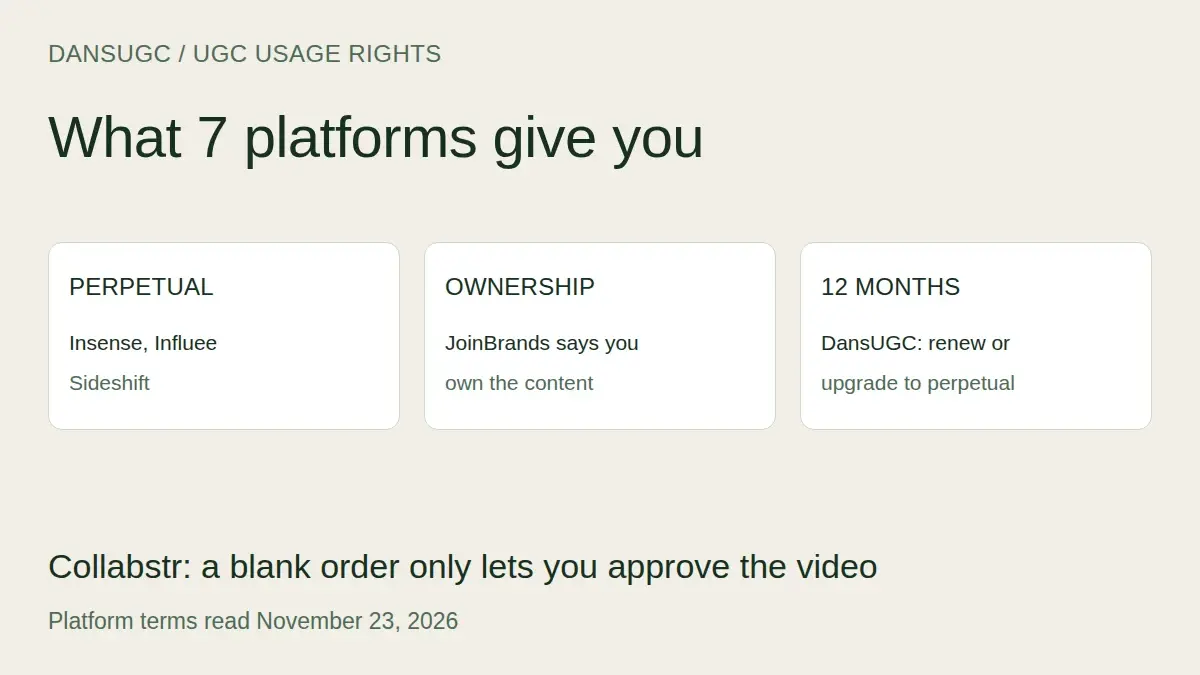
UGC usage rights are the written permission that says where a brand may use a creator's video, for how long, and whether it can run as a paid ad. Paying for a video does not give you those rights by itself: what you get is whatever the platform's terms or your contract say, and on November 23, 2026 we read those terms on seven UGC platforms and found they promise seven different things.
Most guides to this topic explain organic, paid and perpetual rights in general and then say "it depends on your contract." That's true, but if you buy through a platform, the contract is the platform's terms, and almost nobody puts them side by side. This guide does. Every claim about a platform links to the page where we read it.
This is a buyer's guide, not legal advice. For a big campaign or a buyout, have a lawyer read the actual terms.
What are UGC usage rights?
They are a licence: the creator (or the platform acting for them) lets you use the video in set ways while the copyright usually stays with whoever made it. A usage-rights clause answers five questions: which channels (organic posts, paid ads, website, email, TV), how long, which countries, whether you may edit it, and what happens when the term ends.
Two rights sit outside a normal licence and are almost always sold separately:
- Whitelisting, Spark Ads or partnership ads. Running the ad from the creator's own account instead of yours. That needs access to their account, not just the file.
- Exclusivity. Stopping the creator from making content for your competitors for a period.
If neither is written down, assume you don't have it.
Do you own a UGC video once you pay for it?
Usually not. Under US law the person who makes a work owns its copyright, and a commissioned video only becomes the buyer's by default if it is a "work made for hire." The US Copyright Office's Circular 30 on works made for hire sets four conditions for commissioned work: it must fall into one of nine listed categories (part of an audiovisual work is one), there must be a written agreement, the agreement must expressly call it a work made for hire, and both sides must sign it. "If a work fails to satisfy any of these requirements, it is not a work made for hire."
A checkout button on a UGC platform rarely does all four. So in practice what you buy is a licence, and the platform's terms decide how wide it is. That's why the next section matters more than any general rule.
What usage rights do UGC platforms actually give you?
We read each platform's own help page, terms or blog on November 23, 2026, looking for the clause that answers "what can the brand do with the video, and for how long." Here is what each one said, in its own words where it matters.
| Platform | What the page says you get | How long | Running ads from the creator's handle | Source read 2026-11-23 | |---|---|---|---|---| | DansUGC | Non-exclusive, worldwide licence for organic posts and paid ads on any channel, for one brand per purchase | 12 months per purchase (perpetual for purchases before Oct 26, 2026); renew or upgrade to perpetual | Not included unless agreed in writing | dansugc.com/license | | Billo | "A limited, royalty-free, worldwide commercial usage license"; the same answer also says "full licensing and ownership rights are automatically transferred" | No end date stated in the answer to "How long can we use the video?" | Paid add-on, 30 days | Billo help centre, Billo partnership ads | | Insense | "Perpetual digital rights" on "all digital marketing channels"; creators keep ownership | Perpetual | Listed as separate campaign types (Meta partnership ads, TikTok Spark Ads) | Insense help centre | | JoinBrands | "You have full ownership rights" | Not stated (ownership) | Not stated; creators post to their own accounts only in posting-style campaigns | JoinBrands help centre | | Collabstr | Whatever the creator and brand write into the order; if the order says nothing, a licence "solely for the purpose of approving" the video | Set per order | Set per order | Collabstr terms, section 11 | | Influee | "Nonexclusive, worldwide, and irrevocable license to use the content perpetually for commercial purposes" | Perpetual | Not stated on the page | Influee usage rights guide | | Sideshift | "Perpetual rights are included by default" | Perpetual | Not stated on the page | Sideshift usage rights guide |
What the seven pages show:
- "Ownership" means different things. JoinBrands says you own the content. Insense says the creator keeps ownership and you get perpetual digital rights. Billo's answer uses both words, "limited … license" and "ownership", in the same answer. If ownership matters to you (say you want to register the video or resell it as part of a product), ask the platform which one applies before you buy.
- On a marketplace, a blank order can mean almost no rights. Collabstr's terms say that if an accepted order doesn't provide for the transfer of content rights, you get a licence "solely for the purpose of approving the Content Deliverables in the Order, and you acquire no other rights to use, copy, or distribute" them. On a marketplace where you negotiate with each creator, the rights line in the order is the whole deal.
- Perpetual is common, but "digital" may narrow it. Three of the six other platforms say perpetual. Insense's help page lists social media, websites, newsletters, blogs and email, all digital. If you plan TV, outdoor or in-store screens, check that the wording covers them.
- Ads from the creator's account are an extra wherever a page mentions them. Billo sells it as a 30-day add-on; DansUGC excludes it unless agreed in writing. TikTok itself caps the switch: a creator's Spark Ads code lasts 7, 30, 60 or 365 days, chosen by the creator, according to TikTok's Spark Ads help page. The code is a technical permission. Your licence is what says whether you may use it.
What does the DansUGC licence cover, and for how long?
12 months of organic and paid use, worldwide, for one brand, with the option to renew or go perpetual. Since October 26, 2026, every clip, package and custom video bought on DansUGC comes with a 12-month commercial licence; anything bought before that date keeps the perpetual licence it was sold with. You can renew for another 12 months or upgrade a purchase to perpetual at any time, at the price your dashboard shows.
That is a shorter default than three of the platforms above, and we'd rather say so than bury it. The trade-off: a single library clip costs $9 on the Pro plan and $13 without a plan, and packages work out at about $5 a clip (current DansUGC pricing). For comparison, Influee's perpetual rights come with custom videos it lists from $93 each on the same Influee page. Library clips are short: the median DansUGC clip runs 11 seconds, per the 2026 DansUGC Reaction Index. If a clip becomes a long-running winner, the perpetual upgrade is there for that one clip, not the whole order.
The licence also covers some things buyers ask about: AI-assisted editing (cuts, reframing, captions, colour) is allowed; generating new content from the clips, changing the people in them with AI, or training AI on them is not. One purchase covers one brand, so an agency needs a separate purchase per client.
What happens when a UGC licence expires?
On DansUGC, four things, all written in section 4 of the licence:
- Organic posts you published during the term may stay up, but you can't boost, re-share or repost them.
- Paid ads using the clip must stop by the end date, and no new ads may use it.
- You can't publish the clip anywhere new, including edits you made while the licence was live.
- You delete the raw files within 30 days.
Other contracts handle expiry differently: some require organic posts to come down too. Where a platform grants perpetual rights there is no expiry, but the channel limits still apply forever.
The practical risk is forgetting. On DansUGC each purchase has its own end date, and buyers rarely buy once: the 2026 DansUGC statistics show 63.9% of 709 DansUGC buyers licensed clips on two or more separate days, and the median buyer licensed 12 clips (January 20 to November 10, 2026). So most accounts hold clips with several different end dates. Your dashboard shows the end date of each purchase; copy those dates into whatever you use to plan ads.
How much do usage rights add to the price?
On platforms that include rights in the price, nothing extra for the standard licence; you pay more for whitelisting, exclusivity or (on DansUGC) a perpetual upgrade. When you hire creators directly, rights are usually priced as a percentage on top of the creator's fee. Influee's own guide, for example, puts perpetual rights at 100–150% of the base rate and three-month paid rights at 20–30% (Influee, January 2026); treat that as one platform's estimate, not a standard.
A cheaper route for most tests: buy the shortest term that covers the test, and only extend the clips that win. For ready-made footage, compare the per-clip cost first; DansUGC packages and single real-creator clips both include paid-ad use for 12 months, so there is no separate "ad rights" line to negotiate.
What should you check before you buy UGC?
Six questions, in this order:
- Paid ads included? It must say paid or advertising, not just "social media" or "marketing".
- How long, and from when? Purchase date, delivery date or first ad live. DansUGC counts from purchase for clips and from delivery for custom videos.
- Which channels and countries? "Digital" may exclude TV and outdoor.
- Edits allowed? Trimming, captions, combining with other footage, and whether AI editing tools count.
- Creator-handle ads? If you want Spark Ads or partnership ads, that's a separate permission with its own clock.
- What happens at the end? Do organic posts stay up, and how long do you get to wind ads down?
If the platform's page doesn't answer one of them, ask in writing before you pay. For a full buying checklist, see how to buy UGC content; for how the platforms compare on price as well as rights, see Billo vs Insense vs JoinBrands. If you're writing your own creator brief, the UGC drop brief template has a rights section you can copy.
FAQ
Can I use a customer's post that tags my brand?
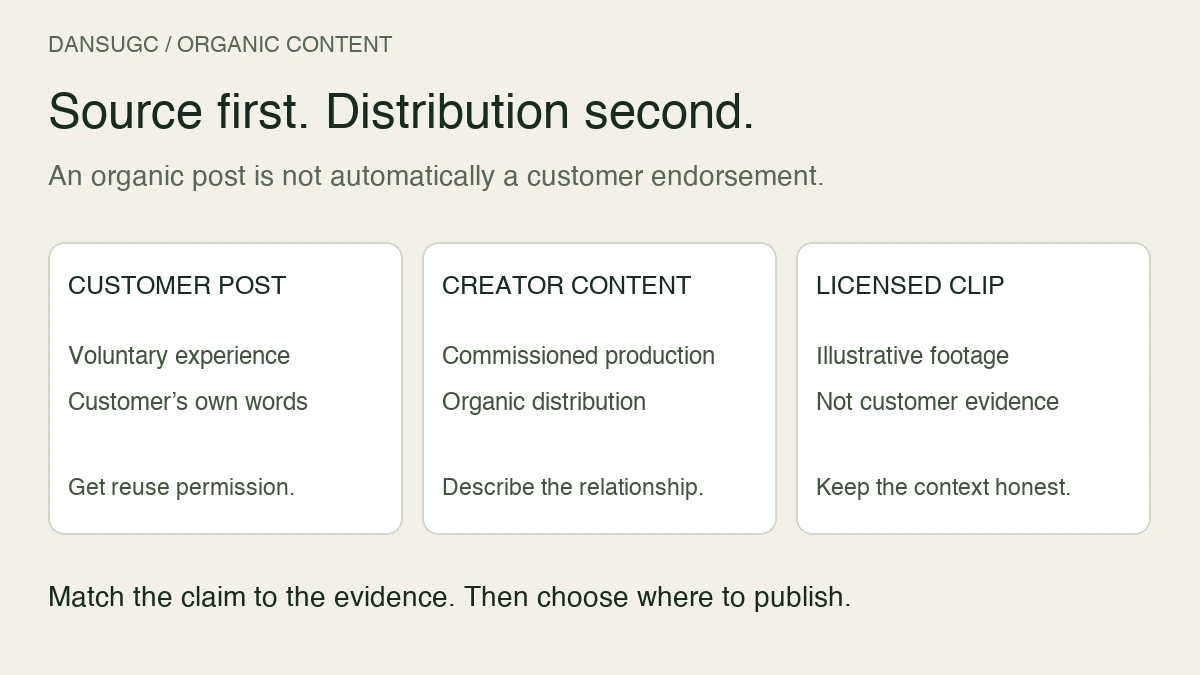
Not in your ads without asking. A tag or hashtag is not permission. Message the person, say where and for how long you want to use the post, and keep their written yes. If you want it in paid ads, offer to pay.
Are usage rights the same as copyright?
No. Copyright is ownership of the video and stays with the creator unless it is assigned in writing or the work qualifies as a work made for hire. Usage rights are the permission the copyright holder gives you.
Can I run a UGC clip as a Spark Ad from my own brand account?
Yes, if your licence covers paid ads: running the video from your own TikTok or Meta account is ordinary paid use. Running it from the creator's account is whitelisting and needs their permission.
Can I use one clip for two brands or two agency clients?
It depends on the terms. On DansUGC, each purchase covers one brand, so a second brand or client needs a second purchase.
What if I keep running an ad after the licence ends?
That's unlicensed use. Pause the ad and renew. On DansUGC a renewal bought after the end date runs from the day you buy it and doesn't cover the gap.
Do ready-made UGC clips come with paid-ad rights?
On DansUGC, yes: every real-creator clip and package includes organic and paid use worldwide for 12 months. Check the terms on any other library before you buy; see our guide to stock UGC video libraries for what else to look for.
Ready to get UGC videos for your brand?
Real human creators, 48-hour delivery, 12-month commercial license. Starting at $9/video.