UGC creator marketplaces for mobile app ads: what a 10-video test costs on each
We priced the same 10-video app test on Insense, Influee, Sideshift and Billo from their pricing pages: $856 to $1,850 in month one, plus the renewals to watch. Real-creator clips for hooks cost $130 for ten.
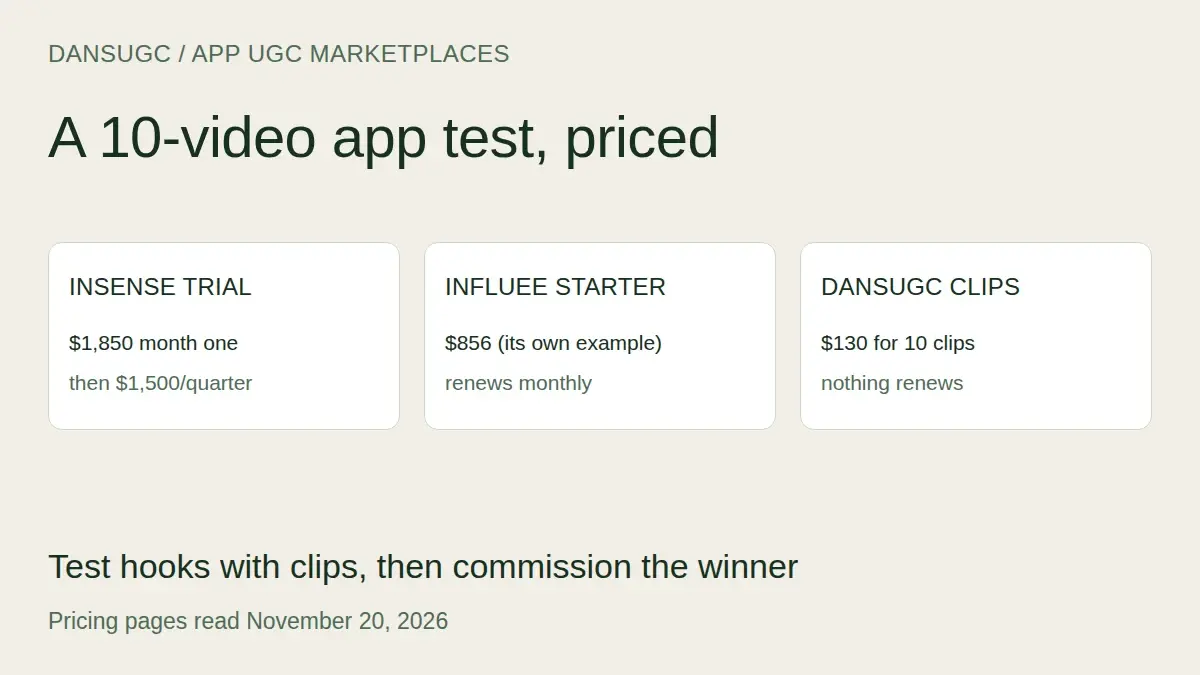
A UGC creator marketplace for mobile app ads is a platform where you post a brief, real creators apply, and you get videos with the rights to run them as paid ads on TikTok and Meta. For an app, the four that matter most are Insense, Influee, Sideshift and Billo, and the real difference between them is not the creators but what you pay before the first video arrives: on the pricing pages we read on November 20, 2026, a 10-video first test ranged from $856 to $1,850 in month one, while ready-made real-creator clips for the hook layer cost $130 for ten.
This guide puts the numbers side by side, says which marketplace fits which kind of app team, and flags the renewals that catch people out.
What does a UGC creator marketplace do for an app?
It replaces the cold outreach. You write one brief, the platform shows it to creators, they apply, you pick, and payment sits in escrow until you approve the video. For an app this matters because there's no product to ship: the creator downloads the app, films a reaction, a screen recording or a talking-head demo, and hands over raw or edited files with usage rights.
What it doesn't do is tell you which angle will win. App ads live or die on the first three seconds, so most app teams need many hooks against one core demo, not ten polished finished ads. Keep that in mind when you compare prices: a marketplace prices finished videos from individual creators, while a clip library prices short real-creator moments you cut into your own ads.
What does a 10-video test cost on each marketplace?
Between $856 and $1,850 in month one on the subscription marketplaces we checked, before you count any renewal. We read each platform's own pricing page on November 20, 2026 and worked out the cash for the same job: 10 videos for a first app test, one month.
| Platform | Platform fee | Creator pay | Fee on creator pay | 10-video month one | What renews | |---|---|---|---|---|---| | Insense Trial | $650 for one month | "UGC campaigns start at $100 per video" | 20% | $1,850 ($650 + $1,000 + $200) | Upgrades to the Brand plan, $1,500 billed quarterly, unless you cancel 48+ hours before the trial ends | | Influee Starter | $229/month | Set by each creator; Influee's US example uses $57, and it lists $93 as the average 30s US video | 10% | $856 with Influee's own example; $1,252 at the $93 US average | Monthly, from the day you publish your first campaign | | Sideshift Starter | $299 month to month ($210/month billed yearly) | Your own budget; Sideshift recommends $2,000–$5,000 a month on Starter | Not stated on the page | $299 + creator budget | Monthly after a 14-day free trial | | Billo | No subscription: you buy a pack and spend the balance for 12 months | Per-video price not shown on the pricing page on Nov 20 | Not stated | Pack price (one customer on the page quotes "10 videos for a grand") | Nothing renews automatically | | DansUGC | $0 on the free plan | $13 per library clip; custom videos from $25 ($250 minimum) | None | $130 for 10 library clips, $250 for 10 custom videos | Nothing on the free plan |
How we worked it out: Insense's figure is the $650 trial plus 10 videos at its stated $100 starting rate plus its 20% marketplace fee. Influee's $856 is the worked example on its own pricing page ($229 + 10 × $57 × 1.10); the $1,252 line uses the same sum with the $93 US average Influee publishes on the same page. Sideshift doesn't publish a per-video creator rate, so we left the creator budget open rather than guess one. Billo's pricing page lists packs and a balance instead of a per-video price, so we quote only what the page says.
If your Insense trial rolls into its first quarter, the first test costs $3,350 rather than $1,850. That's the single biggest number to put in your calendar.
Which marketplace fits which app team?
Pick on how you'll use the videos, not on the creator count on the homepage. The four platforms are built for different jobs.
- Insense fits a team already running paid social at volume that wants creators to post as Spark Ads or Meta Partnership Ads. Its pricing page lists TikTok Spark Ads code sharing and one Meta Partnership Ads connection on the Trial (10 on Brand), and says content can arrive in as few as 7–10 business days. Its FAQ says brands get perpetual digital usage rights once the content is approved and paid for.
- Influee fits a team that wants creators in several countries. The pricing page lists creator costs country by country, from the US to Romania, and gives "content usage rights for all content" on every plan. There's no free trial, but it refunds the subscription if you publish a campaign and don't start a single collaboration.
- Sideshift fits apps whose plan is organic first: creators post on their own accounts, you track views and engagement per creator, then run the winners as ads. Its homepage says the median job collects 284 applications in its first 48 hours, and its example campaign mix leads with app demos.
- Billo fits a team that doesn't want a subscription at all. You buy a pack, the balance lasts 12 months, nothing charges you again, and Billo refunds unused funds if you don't find the right creator within 30 days. Its UGC ads page says it serves "physical and digital products", so an app brief is in scope.
None of these are bad choices. They're priced for teams that will brief creators every month. If you're testing whether UGC works for your app at all, the monthly fee is the part to question.
Where does a clip library fit for app ads?
In the hook layer, before you commission anything. A clip library sells short, already-filmed reactions from real creators that you put in front of your own screen recording, so you can test ten openings for the price of one custom video.
The data from our own marketplace says which openings to try first. The 2026 DansUGC Reaction Index found that surprised, shocked and amazed clips were licensed 4.53 times each on average, against 0.64 for neutral clips, across 7,480 labelled clips and 13,718 licences. The same index found clips of 15 seconds or less took 94.4% of all licences. Advertisers are buying short, surprised faces to open an app demo, not long testimonials.
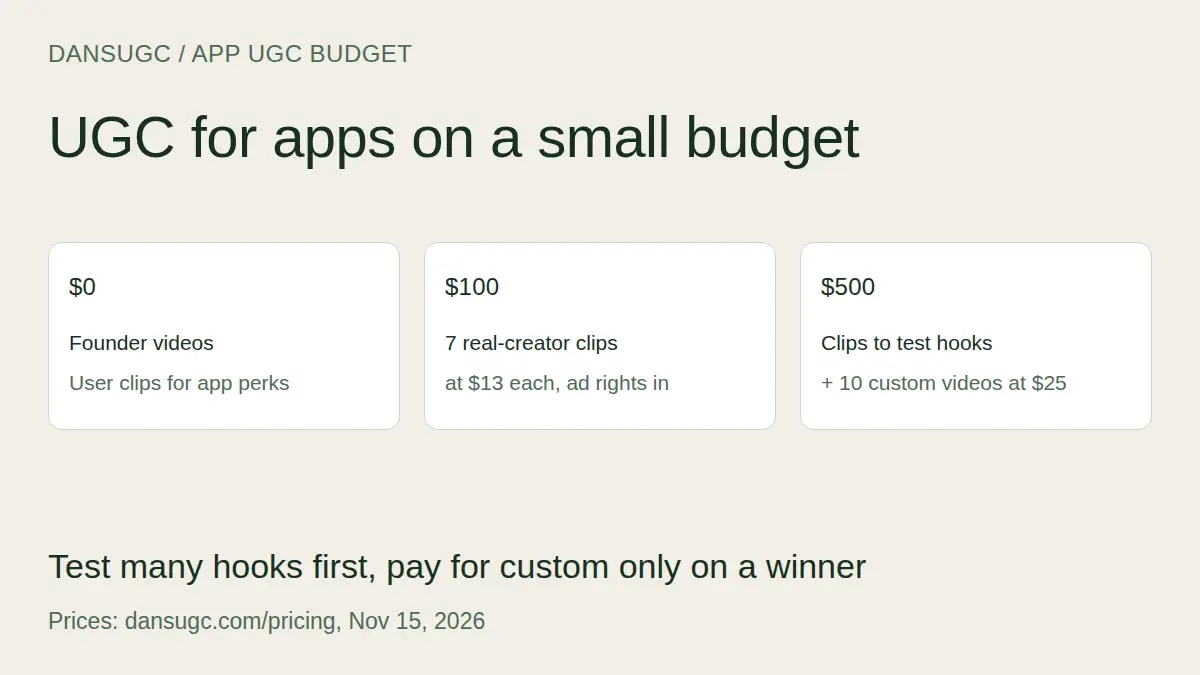
On DansUGC, a single real-creator clip costs $13 without a plan or $9 on Pro, and ready-made UGC packages work out at about $5 a clip. The 2026 DansUGC UGC Price Index found a median of $3.98 per clip across 60 packages. Every purchase comes with a 12-month commercial licence for ads. You can browse the reaction clips by emotion before you spend anything.
The sensible order for a small app team: test hooks with clips, find the angle that holds attention, then pay a marketplace creator to film the full version of the winner. We walk through that budget in UGC for a mobile app on a small budget.
Do app founders say UGC actually works?
Some do, when it's run as ads. We read every reply in the r/AppBusiness thread "Has UGC actually worked for your mobile app?" (August 2026, 23 comments) on November 20, 2026. Of the 8 top-level replies:
- 1 founder called UGC "a giant waste of money" for a social network they'd built.
- 1 said it worked, with a caveat: "We run ads using the UGC. Ads is what works. But you need the content."
- 1, who disclosed they sell UGC tracking software, said to post organically for 2–3 months first and expect 4–6 weeks before traction.
- 1 said UGC works best "when the creator naturally fits the problem", and generic "here's this cool app" videos get scrolled past.
- 1 promoted an AI avatar tool, 1 was deleted, and 2 didn't address the question (one asked the same thing, one was about building marketplaces).
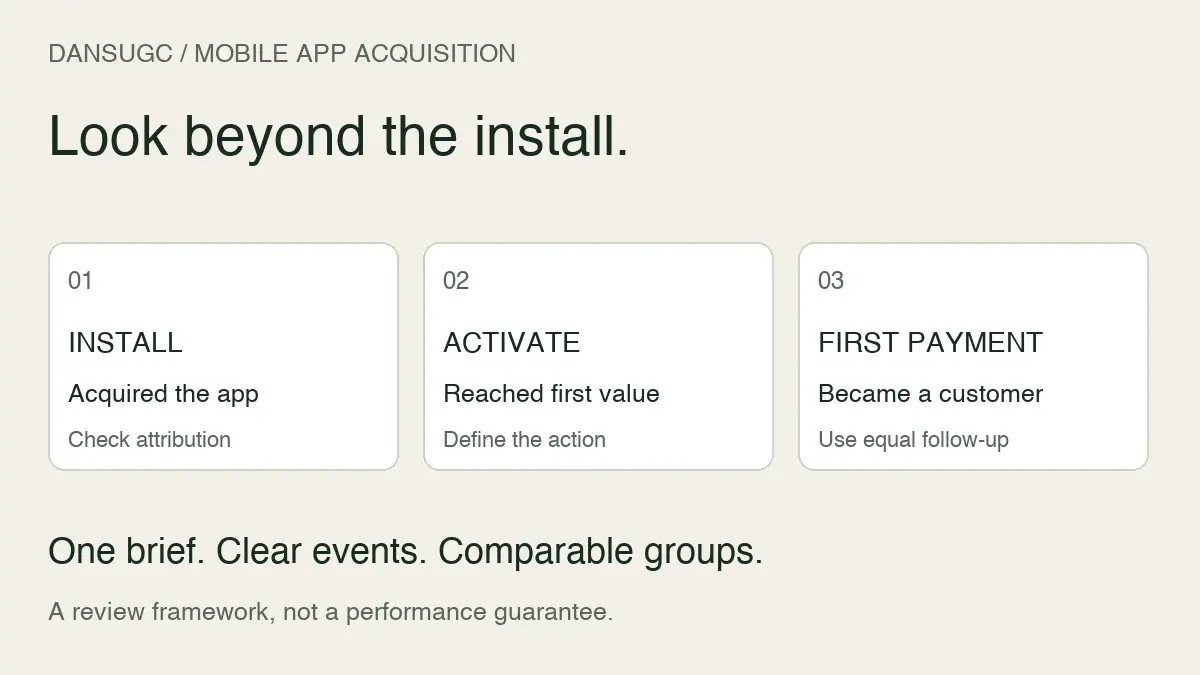
It's a small sample, so read it as a pattern, not a statistic. The founders who were happy treated UGC as raw material for paid ads. The unhappy one expected the videos to work on their own. A marketplace can't fix that; your test plan can.
What should an app brief ask for?
Raw footage, one hook per take, and the rights spelled out. Whichever marketplace you use, put these in the brief:
- The hook, word for word. Give the opening line and the reaction you want ("surprised, then reaching for the phone"). Leave the middle to the creator.
- Raw files plus the edit. Raw clips let you re-cut the first three seconds without paying for a new video.
- A screen recording slot. Say where your app demo goes, so the creator leaves room for it rather than filming a 30-second monologue.
- Paid usage terms. Ask how long you can run it as an ad and where. Insense says perpetual digital rights; DansUGC licenses clips for 12 months; check the terms on any other platform before you pay.
- Spark Ads or Partnership Ads, if you want them. These need the creator to act in their own account, so ask in the brief, not after they've been paid.
Our UA brief and creative scorecard for app ads has a fill-in version, and the reaction video storyboard for app installs shows where the reaction sits against the demo.
Is AI UGC a cheaper alternative for app ads?
Cheaper to make, riskier to run. 62% of US adults say it's unacceptable for businesses to use AI-generated people or voices in ads even when the AI use is disclosed, according to Gallup and Bentley University (3,270 US adults, surveyed May 2026, published August 2026). An app asking for a download is asking for trust, and a synthetic face spends some of it. Every DansUGC clip is a real person filmed on a phone, never AI.
FAQ
What is the best UGC creator marketplace for mobile app ads?
It depends on how you'll run the videos. Insense suits teams running Spark Ads and Partnership Ads at volume, Influee suits multi-country campaigns, Sideshift suits organic-first programmes, and Billo suits teams that don't want a subscription. For testing hooks before you commission anyone, ready-made real-creator clips are the cheaper start.
How much does UGC for app ads cost?
On the pricing pages we read on November 20, 2026, a 10-video first test cost $856 on Influee using its own example, $1,850 on an Insense trial, and $299 plus creator pay on Sideshift. Ten DansUGC library clips cost $130 without a plan. You can model your own numbers with the UGC cost calculator.
Do I need to ship anything to a creator for an app?
No. The creator downloads the app and films with it, so there's no shipping step or product to return. Insense, for example, says delivery speed depends on how fast you hire creators "and ship your product, if required".
Can I run marketplace UGC as Spark Ads or Meta Partnership Ads?
Usually, if you ask. Insense lists Spark Ads code sharing and Meta Partnership Ads connections on its plans, and Billo offers partnership ads from the creator's handle. The creator has to authorise it in their own account, so put it in the brief.
Which marketplace is cheapest to try?
Billo and DansUGC don't charge a subscription, so nothing renews if you stop. Sideshift has a 14-day free trial on monthly plans. Insense's trial costs $650 and upgrades to a quarterly plan unless you cancel at least 48 hours before it ends.
How does this compare with Billo, Insense and JoinBrands for ecommerce?
We ran the same 10-video test for physical products in Billo vs Insense vs JoinBrands. For apps, the shipping step drops out, but the platform fees and renewals stay the same.
Ready to test hooks first? Compare DansUGC plans and per-clip prices or pick a ready-made UGC package for your next app ad.
Ready to get UGC videos for your brand?
Real human creators, 48-hour delivery, 12-month commercial license. Starting at $9/video.