UGC pricing models: per video, projects, packs, and retainers
Separate what you buy from how you pay. Compare UGC assets, projects, packs, subscriptions, and retainers by scope and total commitment.

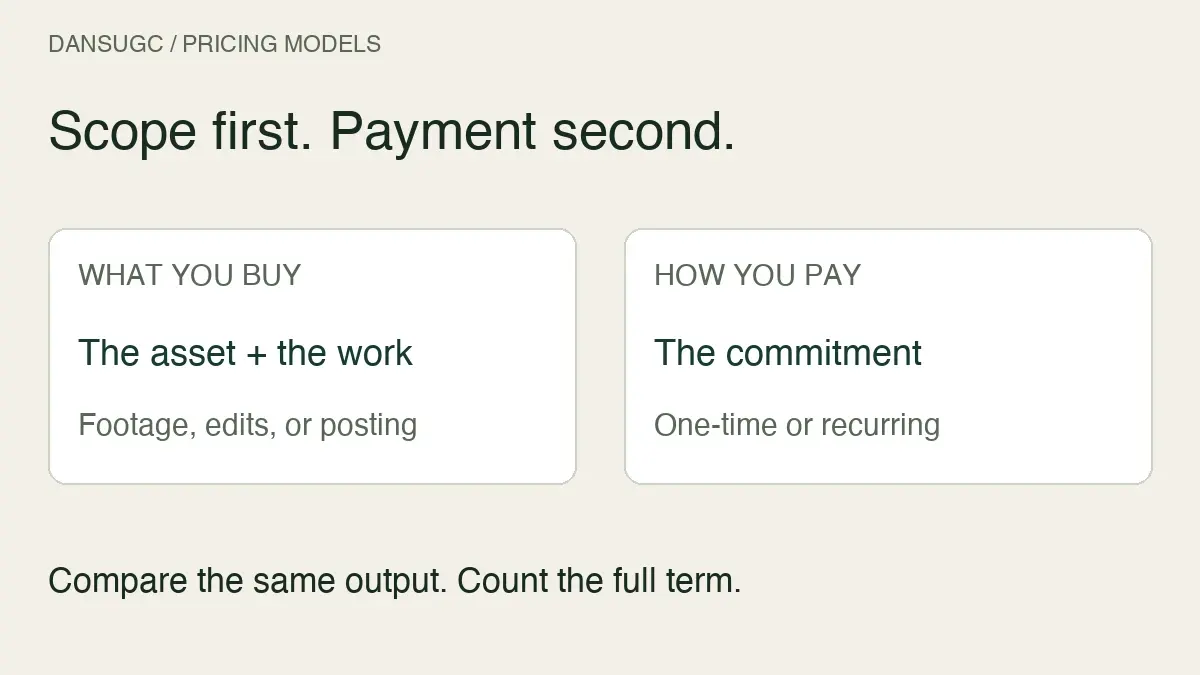
UGC pricing models describe how you pay: per asset, per project, per batch, or through a recurring subscription or retainer. They do not tell you what is included. Before comparing prices, identify whether you are buying existing footage, commissioning a new shoot, paying for editing, or booking a creator to publish. Then compare the same deliverables and intended uses.
A low price for a source clip is not a low quote for a finished campaign. A subscription is not automatically an unlimited production team.
This guide focuses on payment structure and commitment. For a line-by-line production budget, use the UGC cost-per-video guide. The examples below are planning illustrations, not market averages or promised savings.
Separate the payment model from the product
Two questions need separate answers: what work or asset are you buying, and how is it billed?
A library is a source of existing footage. It can be sold through individual purchases, packs, or recurring access. Custom filming is a production task; it can be priced per deliverable, as a project, or through an ongoing agreement. Calling library access a separate pricing model confuses the product with the payment arrangement.
Write the purchase in two parts. For example: “existing reaction footage, purchased individually” or “custom demonstrations, commissioned as one fixed-scope project.” That description is more useful than “cheap UGC.” It reveals whether a quote can solve the actual missing task.
Per-asset pricing: a defined unit at a defined price
Per-asset pricing works best when the unit is clear. Ask whether one asset means a raw take, an edited master, or a format export. Find out whether alternate hooks are new assets or included variations. Do not assume one concept and one file mean the same thing.
This structure can suit an occasional need or a specific gap in an existing edit. The buyer can choose a smaller initial commitment, but separate purchases may still require coordination, editing, and review. Those tasks do not disappear because the footage is inexpensive.
Before buying, record the exact asset, file delivery, intended use, and any work left for your team. If the shot must show your product or a scripted action, an unrelated library clip will not become custom footage just because it is sold per video.
Project pricing: one scope with agreed boundaries
A project quote brings several tasks into one scope. It might include briefing, filming, editing, and exports, but only the actual quote can establish that. Ask for a deliverable list rather than relying on the label “full service.”
Project pricing can make sense when the work has a clear finish line, such as a product launch with specified demonstrations. Its usefulness depends on how well the scope describes what is accepted and what triggers an additional charge.
Confirm who supplies the product, screen recordings, approved wording, and reference material. Agree how feedback is consolidated and distinguish corrections from a new concept. A fixed fee is not necessarily a fixed final cost if the underlying request changes halfway through production.
Packs and batches: several assets, not automatic savings
A pack contains several assets under one purchase. A custom batch groups production requirements together. Either can simplify buying, but the label alone does not establish a discount or a better fit.
Check how many distinct source clips, edited masters, and exports are included. Review whether the content matches your actual shot list. Ten files with minor format changes may be useful, but they should not be counted as ten independently filmed concepts.
Avoid evaluating a pack only by dividing its price by its largest advertised file count. If some files are irrelevant to the project, your immediate usable inventory is smaller. Keep unused material separate from the outputs you have assigned to real publishing slots. Future usefulness is possible, not guaranteed.
Subscriptions: recurring billing for a defined entitlement
A subscription creates a recurring payment obligation in exchange for the stated access, allowance, or service. The important word is “stated.” Check whether the plan provides download credits, discounted purchases, library access, production capacity, or a combination.
Ask how usage is counted, whether unused allowances expire, and whether extra downloads or work cost more. Read the renewal and cancellation terms before treating a displayed monthly figure as a one-month experiment. An annually billed plan expressed as a monthly equivalent is a different cash commitment from a month-to-month plan.
Also check what happens to assets already obtained when the subscription ends. Do not infer ongoing permitted use from the fact that a file remains on your computer. Verify the applicable license and keep its record with the asset. For a closer comparison of recurring and occasional buying, see UGC subscription versus pay-per-video.
Retainers: recurring work requires a capacity definition
A retainer is an ongoing commercial arrangement, not a universal promise of unlimited videos. If you are considering one, clarify what capacity or output the agreement reserves, how requests enter the queue, and who prioritizes them.
Ask what happens when requests exceed the agreed capacity or when your team has nothing ready to brief. Define whether editing, account posting, or reporting is part of the work. A recurring fee can make planning simpler, but an unclear recurring scope can repeat the same disagreement every month.
This differs from downloading existing footage. A library subscription may provide assets without allocating a creator or editor to your business. Compare those offers by responsibility, not merely by whether both charge monthly.
A current DansUGC example—and its limits
On October 11, 2026, the public DansUGC B-roll page displayed individual videos at $15, or $11 per clip when signing up and subscribing, with non-exclusive commercial licensing included. This is a dated example of existing-footage pricing, not a market benchmark or a quote for custom filming.
The per-clip statement does not, by itself, explain the full recurring commitment, credit rules, or every license condition. Read the current plan and checkout details before deciding what you will pay. Prices and terms can change.
Non-exclusive also matters: do not assume an existing clip is reserved for your brand alone. If exclusivity, a specific product action, or creator-account distribution is essential, confirm that requirement before purchasing. DansUGC is the publisher of this guide and offers the library linked here.
Compare two offers using one purchase specification
Before requesting prices, write a short specification both suppliers can answer:
- Asset: existing footage or newly recorded content; raw takes or finished edits.
- Quantity: distinct sources, edited masters, hooks, and exports counted separately.
- Work: who briefs, films, edits, reviews, and publishes.
- Use: intended channels, duration, territories, and any exclusivity requirement.
- Delivery: required formats, schedule, revision scope, and acceptance criteria.
- Payment: upfront amount, recurring amount, minimum term, and possible extra charges.
- Exit: cancellation process, unused allowance treatment, and continued permitted use.
Mark an unanswered item as unknown. Do not silently treat it as included or free. The UGC rate-card guide provides more detail for comparing the scope of individual quotes.
An illustrative commitment comparison
Imagine Offer A is a one-time $240 purchase for six specified source clips. Offer B is $180 per month with a three-month minimum and a monthly allowance of six source clips. These figures are invented for the example; neither is a DansUGC offer.
Offer A commits $240. Offer B commits $540 across its minimum term, even though its first month's charge is smaller. If you only have a defined use for six clips, the larger theoretical allowance does not automatically make B the better purchase. If you have ongoing relevant needs, B may be worth examining—but first check the exact allowances, suitability, and terms.
Now suppose neither offer includes editing. The comparison is still about source footage, not the cost of six finished posts. Add the work your team must supply before comparing a source-only offer with a finished-video project. Keep quoted facts separate from your own estimates.
Choose the model after defining the next usable output
For one missing existing shot, inspect per-asset availability. For a product-specific scene, define the custom production scope. For repeat needs, compare the recurring arrangement against realistic usage and the team's capacity to finish the work.
There is no payment model that makes poor-fit footage useful. Nor does buying more output establish that it will produce more customers. Start with a complete, reviewable use case and choose the commitment that fits it.
Common questions
How much do UGC creators cost?
There is no single price implied by the job title. Ask for a quote against the specific filming, editing, posting, and permitted-use requirements. Existing-footage prices are not a proxy for a custom creator quote.
Are UGC subscriptions always cheaper?
No. Compare the full commitment and the assets you can actually use. A lower displayed unit price can coexist with a larger total payment or unused allowance.
Does paying per video include editing?
Only when the offer says so. Confirm whether the unit is a raw source clip, an edited master, or a format export, and record what remains for your team.
Is library access the same as hiring a creator?
No. Library access lets you choose from existing material under its terms. Hiring a creator commissions defined work. Either can be sold through different payment structures.
Updated October 11, 2026: clarified products versus billing models, removed unsupported savings assumptions, and added a dated first-party example and hypothetical commitment comparison. The original diagram is explanatory, not performance data.
Ready to get UGC videos for your brand?
Real human creators, 48-hour delivery, full commercial rights. Starting at $9/video.