UGC rates in 2026: compare quotes, clips, and finished videos
Compare UGC quotes by deliverable, not headline price. Includes current DansUGC format examples, a copyable rate-card template, and questions to resolve before paying.

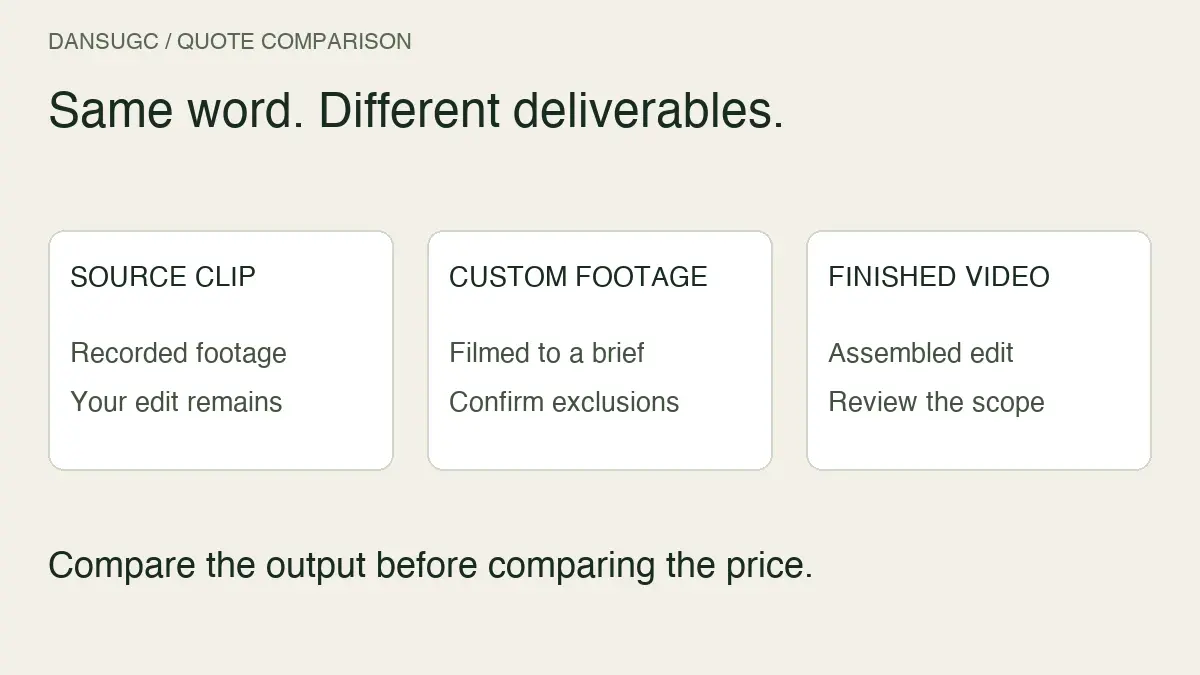
UGC rates only make sense when you know what the price includes. A creator's filming fee, an existing library clip, and a finished video commissioned for your product are different purchases. Compare the deliverable, editing, permitted uses, revisions, and total scope before comparing the headline price.
The cheapest file is not always the cheapest finished video.
I run DansUGC. This guide helps buyers compare quotes and gives creators a rate-card structure they can adapt. It is not a survey of market-average rates. Product examples were checked on October 2, 2026; they are starting offers, not a promise that every brief costs the same.
First, name the thing you are buying
Before asking whether a quote is expensive, write down its unit. “One video” leaves too much room for two people to mean different things.
- Existing source clip: recorded footage selected from a library. Check whether the shot fits your edit and whether its permitted uses match your project.
- Custom filmed asset: footage recorded to a supplied brief. It may be a reaction or spoken script rather than a complete advertisement.
- Finished video: an assembled edit with the agreed sequence, captions, audio, and export format. Specify what “finished” means.
- Creator distribution: a creator posting to their own audience. Do not assume posting is included when you buy production.
For the broader sourcing decision, see UGC clips vs custom UGC. Here, the job is narrower: compare offers without mixing their units.
Current DansUGC custom format examples
On October 2, 2026, the live DansUGC custom order page displayed two starting offers:
- Reaction Video: from $25 per video. The format includes reactions, emotions, scripts, and lip-sync. It describes unedited human footage and specifically excludes app demos.
- Full UGC: from $100 per video. The format includes edited UGC, app demos, and walkthroughs, with a finished edit plus original footage.
These are not two prices for identical work. The first supplies footage for your edit. The second describes a finished production. Confirm the exact deliverables for your brief rather than assuming a low-cost reaction includes a product walkthrough.
The order page says to review quantity savings and the exact price with your brief before paying. A “from” price does not establish the final price for your chosen quantity, creator, or scope. Ask about any minimum order, additional work, and the final total before committing.
Older versions of this article listed Face Reaction, Talking Head, and Full UGC prices captured on September 17. The order interface has since changed. Those older figures are not the current rate card and have been removed from this comparison.
The B-roll library is a separate route for existing footage. A custom-production starting price is not a library price. Likewise, access to a library does not mean a creator will film your product or script.
Copy this UGC rate-card template
A useful rate card defines an offer before it names a number. Use this structure for each package. Replace the placeholders with confirmed details; leaving a field blank is better than quietly promising work you have not priced.
- Offer name: [one specific deliverable, not “UGC package” alone].
- Base price and currency: [amount], valid until [date].
- Quantity: [number of source clips] and [number of finished edits], listed separately.
- Recording scope: [script length or agreed duration], [scenes], [location], [language], [product requirements].
- Editing included: [captions, audio, graphics, aspect ratios, export files].
- Raw footage: [included, excluded, or separately quoted].
- Included uses: [the uses agreed with the buyer], with any limits clearly recorded.
- Creator posting: [included or excluded], with a separate scope if included.
- Review process: [included revisions], [feedback deadline], [what counts as a new request].
- Timing: [first delivery] after [required inputs arrive], plus any agreed review window.
- Additions: [extra scene, new script, rush work, additional edit], each confirmed before work begins.
- Payment and other terms: [deposit or payment timing], [applicable taxes/fees], and a reference to the actual agreement.
This is a production-scoping template, not legal advice or a substitute for an agreement. Confirm the intended use in writing. Do not infer rights from a filename, a download button, or a casual “all included” message.
Creators should base their price on the work and expenses they actually undertake: preparation, filming, editing, communication, revisions, and delivery. Someone else's historical sourcing cost is not a suggested rate for your business. A customer-facing retail price is also not proof of a creator's take-home earnings.
Send the same brief before comparing quotes
If one supplier receives a detailed script and another receives “make something viral,” their quotes will not tell you much about relative value.
Send each supplier the same required output, product context, reference material, deadline, and intended use. Ask them to identify exclusions rather than silently filling the gaps in their own way.
For a batch, use the UGC drop brief template. Attach the approved scope to the order so the reviewer checks what was purchased, not what they remember discussing.
Then compare these three things:
1. Does the quote cover the missing scene?
If you need a creator demonstrating your physical product, a library reaction is not a substitute simply because it costs less. If you already have the product demo and only need an opening reaction, commissioning a full production may solve more than the actual gap.
Write the missing shot before choosing the package. This keeps the purchase attached to a real production need.
2. What remains for your team to do?
List the work after delivery: recording product footage, writing the final sequence, adding captions, selecting audio, adapting aspect ratios, or creating an end frame. Assign an owner to each task.
A lower supplier invoice can still leave more internal work. That does not automatically make it a worse choice. It means your team needs the time and ability to finish it.
For a total-cost calculation with a worked example, use the separate UGC production budget worksheet. Keep this quote comparison focused on scope; do not turn a clip price into an unsupported cost-per-customer claim.
3. What happens when the brief changes?
Ask the supplier to distinguish a correction from a new request. Fixing a caption typo is not the same task as filming a new scene or replacing an approved script.
Agree who approves the script, when consolidated feedback is due, and how additional work is priced. Avoid vague assumptions about unlimited revisions. A clear approval process is useful to both the buyer and the creator.
A practical quote-normalization example
Suppose your team needs six finished product explainers. This is an illustrative scenario, not a customer result or a priced DansUGC offer.
One quote supplies six reaction clips. Another supplies six edited videos with product demonstrations. Before comparing totals, mark the first quote as “source footage only” and the second as “finished edits.”
Now ask what your team must supply under each option. With the first, that could include six demo recordings, scripts, editing, captions, and review. With the second, you still need to confirm whether the demonstrations use your real product, whether the scripts are included, and what review covers.
Only compare like-for-like totals after those gaps are resolved. If a required item cannot be supplied, mark the offer unsuitable rather than assigning it a guessed extra charge.
The point is not to make either model win. It is to avoid paying for one product while expecting another.
How to read a subscription or credit offer
Separate the payment method from the deliverable. Paying monthly does not, by itself, say whether you receive finished videos, purchasing credit, catalog access, or a defined production service.
Check what the plan actually funds, what each purchase consumes, when benefits expire or renew, and which work is separately scoped. Do not divide a fee by every asset in a catalog and call that your usable cost per video.
Also separate a library's available inventory from footage that fits your brief. A large selection is only useful if it contains the scene, expression, or context your edit needs.
Questions to resolve before paying
What should a UGC creator rate card include?
A defined output, base price and currency, filming and editing scope, included uses, posting requirements, revisions, timing, and separately priced additions. The buyer should be able to see both what arrives and what is excluded.
Is a reaction clip the same as a finished UGC ad?
No. A reaction can be one source shot inside a video. A finished edit may also need product footage, a script, captions, audio, and an ending. Ask for a deliverable list rather than relying on the word “video.”
Are usage permissions always an extra charge?
Do not assume either way. They may be included or quoted separately. Confirm what your specific agreement permits and whether it covers the intended channels and duration before publishing.
Does a starting price tell me the final order total?
No. Review the selected format, quantity, creator, brief, and any additional scope. Use the confirmed total for your purchasing decision, not a starting figure taken out of context.
Can an old creator-cost post be used as today's price list?
No. A dated post may describe a historical sourcing example or a previous offer. It does not establish current availability, customer pricing, or the terms of a new order.
Choose the scope first
Write the missing scene. Choose existing footage when it fits; commission filming when your product, words, or action must appear. Compare the confirmed deliverables and the work left for your team before choosing the lower headline price.
Updated October 2, 2026: current custom format examples replace the September 17 price snapshot. This revision adds a copyable rate-card template and a quote-normalization workflow, and moves detailed budget arithmetic to the dedicated production-cost guide. It does not claim an average market rate or a guaranteed business result.
Ready to get UGC videos for your brand?
Real human creators, 48-hour delivery, full commercial rights. Starting at $9/video.