AI video ads: the cost per winner nobody quotes
every ai video ad generator quotes a price per video. none of them quote the number that decides your budget, which is how many videos you have to make before one works. here is the denominator, the distribution cost nobody lists, and where ai footage genuinely is the right call.


ai video ads are short video advertisements generated from a text prompt rather than filmed, usually with a synthetic presenter reading a script to camera. they cost between $8 and $12 per finished video across the main tools. that per video price is the number every vendor puts on its pricing page, and it is the wrong number to budget against.
the number that decides your spend is cost per winner.
what the results page for this term actually looks like
we pulled the live google results for "ai video ads" on 19 august 2026. the top of the page:
- an ai overview, above everything
- 1. creatify
- 3. invideo
- 5. a reddit thread titled "Anyone Make AI Video Ads Work?"
- 6. mit's initiative on the digital economy
- 8. runway
- 9. canva
- 10. heygen
- 11. zeely
- 13. nextify
nine of the first thirteen slots are tools selling generation. the two that are not are a research institute and a room full of buyers asking each other whether the category works at all.
that gap is the whole article. the supply side publishes cost per video. the demand side is on reddit trying to work out cost per result, because nobody sells them that number.
the arithmetic vendors leave out
an ad budget is not price times videos. it is price times videos divided by hit rate.
```
cost per winner = (cost per video x videos made) / winners
```
the vendors control the first term and publish it. you control the second. nobody publishes the third, and the third is the one with the biggest multiplier on it.
work an example with round numbers. treat these as illustration rather than measurement, because the hit rate half is yours to fill in from your own account.
first, at equal hit rates, which is the comparison the pricing pages invite you to make:
- ai generated: $10 per video, 20 videos to find one winner, $200 per winner
- real reaction footage: $5 per video, 20 videos to find one winner, $100 per winner
now the same maths with the hit rates pulled apart:
- ai generated: $10 per video, 40 videos to find one winner, $400 per winner
- real reaction footage: $5 per video, 15 videos to find one winner, $75 per winner
in the first pair the gap is just the 2x on unit price. in the second the unit price barely moves the answer and the denominator moves it by more than 5x.
so the only question worth arguing about is whether synthetic footage and real footage convert at the same rate. dan's position is that they do not, and he has been specific about why.
the denominator problem, in dan's words
when sora landed, dan's read was that the ceiling is human detection, not model quality. his words: the model is good, the internet is about to fill with this content, and humans are very good at spotting ai generated video. he goes further and says tiktok, instagram and youtube have tuned toward human authentic content in response. that last part is his read of platform behaviour, not a published platform policy, and worth treating as such.
we are not going to hand you a hook rate comparison here, because the measured version of that argument already lives on one page and belongs there: ai ugc vs real human ugc has the split with the source post attached.
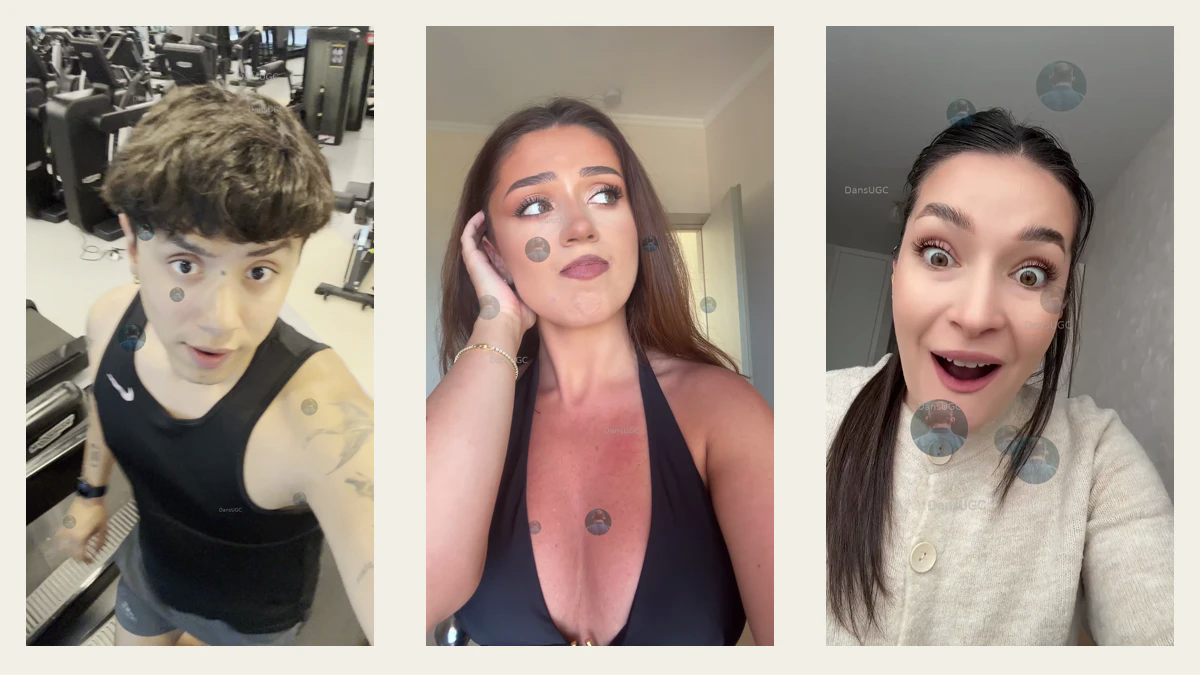
that clip costs $7.50. what it is actually selling is the half second where the surprise turns into a smile, which is the exact transition that reads as synthetic when it is generated.
the line item nobody puts on the pricing page
there is a third cost in the equation and no ai video tool lists it, because it is not their problem.
getting the video seen.
dan pays $90 for a us hosted tiktok account and describes distribution as the real bottleneck in scaling content. that is a per channel cost that sits on top of every creative cost, and it does not care whether the video was generated or filmed.
it changes the ranking though. if distribution is fixed and expensive, every slot you fill with a creative that will not land is more costly than the creative itself. a $10 video that dies is not a $10 mistake. it is $10 plus the slot.
where ai video genuinely is the right call
this is not a case for never generating anything. there are three places it holds up:
- motion, type and product-on-table shots. nobody is reading a face. generate them
- localising a proven winner. you already know the ad works. swapping captions or a voice track into another language is a translation job, not a creative one
- pre-production concepting. generating six versions of an angle to decide which one to film is cheaper than filming six. treat the output as a storyboard and throw it away
the pattern is consistent. ai is fine wherever the audience is not being asked to believe a person. it degrades exactly where they are.
that is 14 seconds and $5. two distinct emotional beats in one take, in a real living room, with the lighting a real living room has.
what to buy instead, and what it costs
we queried the library on 19 august 2026: 211 clips featuring a male creator score 70 or above on virality, and 454 do at the same threshold when filtering for surprise. that is inventory, not a render queue, so the price is fixed before you buy and there is no reroll.
- reaction clips start at $5 in the b-roll library, full commercial rights, no watermark
- the whole pricing page is one screen, because there is no subscription to explain
- if the beat you want is not in the catalogue, custom orders are $9 per video with a 20 video minimum
questions people actually ask
do ai video ads work?
they produce ads. whether they produce winners at the same rate as filmed footage is the open question, and it is the only one that matters to your budget. test both against your own hit rate before committing a quarter to either.
how much do ai video ads cost?
$8 to $12 per finished video across the main generators in 2026. real reaction footage runs $5 to $55 per clip depending on tier, and $9 per video on custom orders.
can people tell a video is ai generated?
dan's position, published in october 2025, is that they can and that platforms have adjusted for it. treat that as an experienced operator's read rather than a measured study, and check it against your own retention curve.
what should i generate and what should i film?
generate anything without a human face in it. film anything where the viewer is being asked to believe a person.
the short version
- cost per video is the number vendors publish. cost per winner is the number that sets your budget
- the hit rate denominator moves the answer more than unit price does
- distribution is a real cost line that sits on top of both, and $90 per us hosted account is dan's figure for it
- generate the shots nobody looks at. film the ones they do
start with the b-roll library if you want to test the filmed half against whatever you are generating now.
Ready to get UGC videos for your brand?
Real human creators, 48-hour delivery, full commercial rights. Starting at $9/video.