Why AI UGC Can't Replace Real Human Reactions (And Probably Never Will)
The Temptation: AI tools can now generate user-generated content at scale for a fraction of the cost of working with real creators. The technology is impressive, the output looks polished, and the efficiency seems unbeatable. The Reality: Consumers have developed sophisticated detection mechanisms for identifying synthetic content. AI-generated UGC lacks the micro-expressions, environmental authenticity, and genuine emotional resonance that make real UGC effective.

The pitch sounds compelling: generate unlimited user-generated content instantly, at a fraction of traditional costs, with complete control over messaging and production quality. No more managing creator relationships, waiting for deliverables, or dealing with content that doesn't quite hit your brief.
AI-generated UGC tools have proliferated over the past two years, promising to revolutionize how brands create authentic-looking customer content. The technology is genuinely impressive. The economics appear unbeatable. The efficiency gains seem obvious.
There's just one problem: it doesn't actually work as well as real UGC.
I've spent the past eighteen months testing AI-generated content against real customer reactions across dozens of campaigns, and the results are consistent. Real human reactions outperform synthetic alternatives by significant margins in almost every meaningful metric. Click-through rates, conversion rates, engagement, brand perception, and long-term customer value all favor authentic content over AI simulations.
This isn't about AI technology being "not ready yet." This is about fundamental limitations in what synthetic content can achieve, regardless of how sophisticated the technology becomes. Let me show you why real human reactions remain irreplaceable.
The Authenticity Problem: What AI Can't Replicate
User-generated content works because it represents authentic social proof. When potential customers see real people genuinely enjoying your product, they mentally project themselves into that experience. This emotional connection is what drives UGC's superior conversion performance compared to traditional brand content.
AI-generated content can mimic the visual format of UGC. It can create videos that look superficially similar to what a real customer might record. But it cannot create the actual authenticity that makes UGC effective, because the content fundamentally isn't authentic.
The Uncanny Valley of Marketing Content
You know that unsettling feeling when you see a CGI human character that's almost realistic but something feels slightly wrong? That's the uncanny valley effect, and it applies to marketing content just as much as it does to visual effects.
AI-generated UGC often lands squarely in the marketing uncanny valley. The lighting is a bit too perfect. The background is suspiciously clean. The enthusiasm feels scripted. The emotional reactions don't quite match the intensity you'd expect from someone genuinely excited about a product.
These subtle inconsistencies register subconsciously even when viewers can't articulate exactly what feels off. The result is reduced trust, lower engagement, and worse conversion performance.
What Authentic Reactions Actually Look Like
Real customer reactions contain dozens of micro-elements that AI struggles to replicate convincingly:
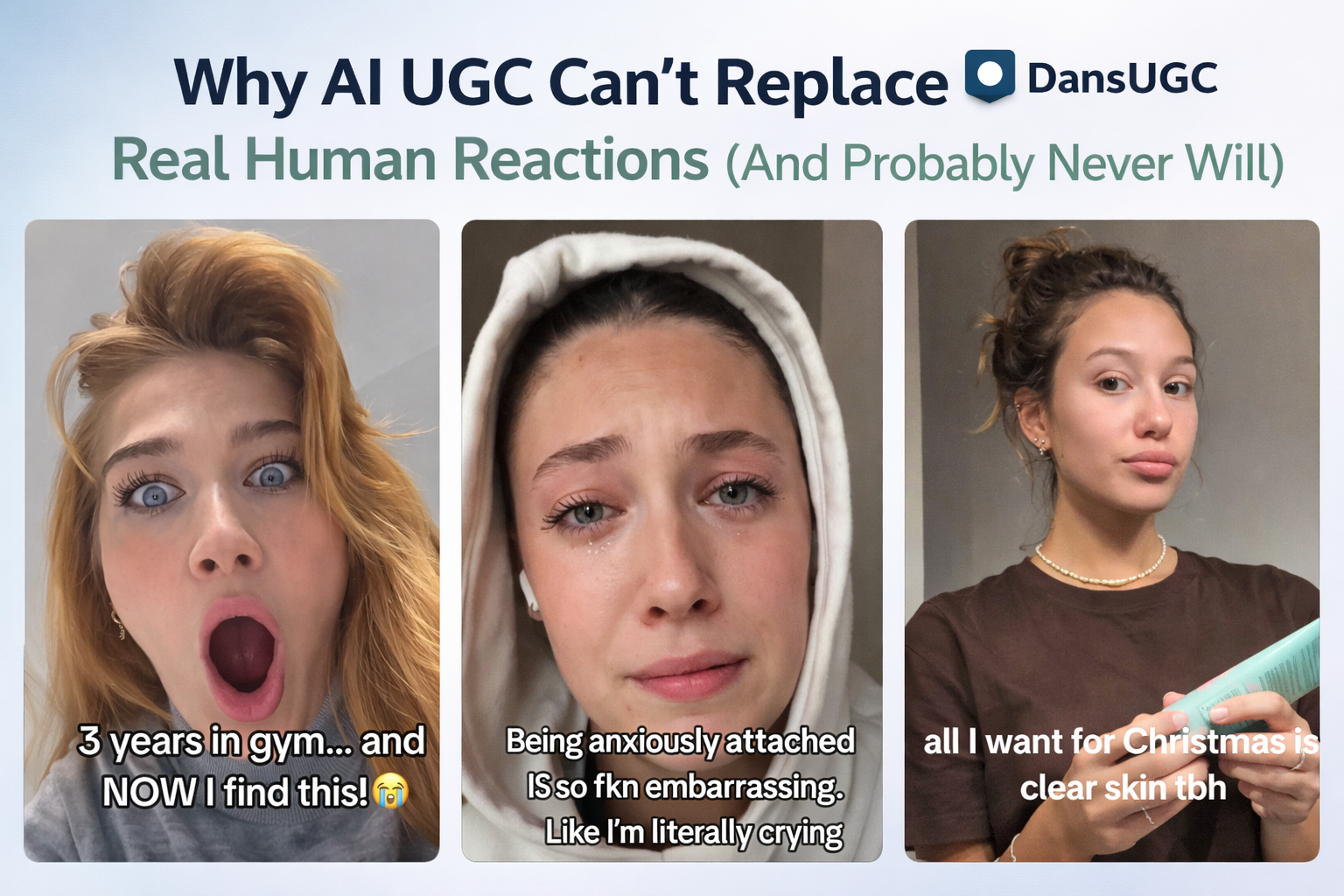
Genuine surprise registers differently than performed surprise. When someone opens a package and experiences unexpected delight, their facial expressions follow specific patterns that are extremely difficult to fake or simulate convincingly.
Environmental authenticity matters more than most marketers realize. Real customer videos contain background details that place the content in real contexts: family members moving in the background, pets investigating the product, real kitchens and bedrooms with actual lived-in characteristics.
Spontaneous language patterns differ from scripted speech. Real customers use filler words, self-correct, repeat themselves, and express thoughts in naturally disorganized ways. These "imperfections" actually increase credibility because they signal authentic, unrehearsed communication.
Genuine enthusiasm creates different energy than performed enthusiasm. When someone truly loves a product, their excitement manifests through vocal tone variations, physical energy, and authentic passion that's noticeably different from someone reading a script or following a brief.
AI can approximate these elements individually, but creating content that convincingly integrates all of them simultaneously while maintaining authenticity remains beyond current capabilities. More importantly, even if the technology improves, the content still wouldn't be authentic because it wasn't created by a real customer having a real experience.
The Performance Gap: Real Numbers From Real Tests
Theory is interesting, but data matters more. What actually happens when you test AI-generated UGC against real customer content in live campaigns?
I've run systematic A/B tests comparing AI-generated content to real UGC across multiple clients in e-commerce, SaaS, and service businesses. The results are remarkably consistent across industries and offer types.
Conversion Rate Performance
In direct response advertising (Facebook, Instagram, TikTok ads), real UGC consistently outperforms AI-generated alternatives by 35-60% in conversion rate. This isn't a small difference. This is the gap between a profitable campaign and one that barely breaks even.
A beauty brand tested 20 AI-generated product demonstration videos against 20 real customer videos in their Facebook ad campaigns. Budget allocation was identical. Targeting was identical. Ad copy was standardized. The only variable was content authenticity.
Real customer videos achieved a 3.2% conversion rate on average. AI-generated videos achieved 1.4% conversion rate. The real UGC outperformed by 129%. When you calculate cost per acquisition, the "expensive" real content delivered significantly better ROI than the "cheap" synthetic alternative.
Engagement Metrics Tell the Story
Beyond conversions, engagement patterns reveal how audiences respond to authentic versus synthetic content. Real UGC generates 40-70% higher engagement rates (likes, comments, shares) across organic social platforms.
More tellingly, comment sentiment differs dramatically. Real customer content generates comments like "This looks so real, I need to try this" and "Her reaction is exactly how I felt when I got mine." AI-generated content generates comments like "This feels like an ad" and "Is this even a real person?"
Audiences are far more sophisticated than marketers often assume. They can sense inauthenticity even when they can't precisely articulate why content feels synthetic.
Long-Term Brand Perception Impact
The performance gap extends beyond immediate conversion metrics into long-term brand perception. Brands extensively using AI-generated "UGC" face reputation risks when audiences discover the content isn't authentic.
Consumer trust in brands has declined steadily over the past decade. When customers learn that a brand's "real customer reactions" were actually synthetic creations, that trust erodes further. The short-term cost savings from AI content can create long-term brand damage that far exceeds any efficiency gains.
Why "Good Enough" Isn't Good Enough
Some marketers argue that AI-generated content doesn't need to be perfect. It just needs to be "good enough" to improve performance over traditional brand content while costing less than real UGC.
This perspective misunderstands what makes UGC effective in the first place.
The Binary Nature of Authenticity
Authenticity isn't a spectrum where "90% authentic" delivers 90% of the value. It's closer to a binary: either content is genuinely from a real customer or it's not. Once audiences sense content is synthetic, it loses the core attribute that makes UGC valuable.
You cannot be "kind of" authentic. You cannot deliver "most of" the social proof value. Either the content represents a real customer's genuine reaction, or it's just another form of brand messaging dressed up to look like something it's not.
The Compounding Effect of Audience Sophistication
Consumer ability to detect synthetic content is improving rapidly. What might have been "good enough" in 2023 is obviously fake in 2026. As audiences become more sophisticated, the bar for "convincing" continues rising.
This creates a treadmill where brands must invest increasing resources into making AI content look more authentic, chasing an audience that's simultaneously getting better at detection. Meanwhile, real UGC maintains its effectiveness because it's actually authentic, requiring no additional investment to remain convincing.
Platform Algorithm Considerations
Major advertising and social platforms are beginning to incorporate content authenticity signals into their ranking and delivery algorithms. Content identified as synthetic or heavily manipulated receives reduced distribution compared to authentic user content.
Instagram and TikTok have both updated their algorithms to prioritize "authentic" content, though they don't publicly specify exact criteria. Facebook's advertising system increasingly factors content quality and authenticity into delivery optimization.
Using AI-generated UGC may result in reduced platform performance beyond just lower audience response rates. The platforms themselves may deprioritize your content, compounding the performance gap.
The Specific Elements AI Struggles to Replicate
Let's examine the specific aspects of real human reactions that AI tools consistently fail to replicate convincingly, even as the technology improves.
Micro-Expressions and Genuine Emotion
Human facial expressions contain incredible nuance. A genuine smile activates different muscle groups than a fake smile. Real surprise creates specific temporal patterns in eyebrow movement, eye widening, and mouth opening that are extremely difficult to simulate.
These micro-expressions happen in milliseconds and operate largely below conscious awareness, but viewers process them subconsciously. When facial expressions don't match the emotional context, audiences sense something is wrong even if they can't explain what.
AI-generated faces have improved dramatically, but they still struggle with the subtle complexity of authentic emotional expression. The timing is slightly off. The intensity doesn't quite match. The combinations of expressions don't flow naturally.
Real customers experiencing genuine product satisfaction display authentic emotional reactions that AI cannot convincingly fake, regardless of technical sophistication.
Environmental Context and Lived-In Spaces
Real customer videos are filmed in real homes, real cars, real workplaces, and real environments. These spaces contain thousands of details that establish authenticity: family photos on walls, dishes in the sink, pets wandering through the frame, natural lighting variations, background noise from daily life.
AI-generated content either creates suspiciously clean environments devoid of these details, or attempts to add them artificially in ways that don't quite look right. The accumulation of small environmental inconsistencies triggers subconscious inauthenticity detection.
A customer filming a skincare routine in her actual bathroom at 7am before work creates environmental authenticity that's nearly impossible to replicate artificially. The natural morning light, the products scattered on the counter, the tired-but-optimistic energy, the casual clothing all contribute to an authentic context that builds trust.
Spontaneous Language and Natural Communication
Real people speak differently than scripted content sounds. They use filler words ("um," "like," "you know"). They self-correct mid-sentence. They occasionally lose their train of thought and circle back. They use inconsistent grammar and casual vocabulary.
These "imperfections" are actually markers of authentic human communication. When content sounds too polished, too scripted, or too perfect, it triggers skepticism.
AI-generated voice content has improved significantly, but it still tends toward either obviously synthetic speech patterns or unnaturally perfect delivery. Real customer testimonials contain the messy spontaneity of actual human speech, which paradoxically increases credibility despite being technically "worse" communication.
Product Interaction Authenticity
Real customers interact with products in realistic ways. They struggle slightly with packaging. They hold items at natural angles. They use products in real contexts rather than staged demonstrations.
AI-generated content often shows product interaction that's too perfect or follows too obviously scripted patterns. The unboxing is too smooth. The application is too practiced. The usage scenario is too idealized.
These subtle differences matter because viewers are evaluating whether the content represents realistic experience they might have. When product interaction looks staged or simulated, it reduces the ability for viewers to imagine themselves having the same experience.
The Trust Equation: Why Deception Costs More Than Honesty
Using AI-generated content disguised as real customer reactions isn't just ineffective. It's potentially damaging to brand trust in ways that extend far beyond individual campaign performance.
When Audiences Discover the Truth
Consumers are increasingly aware that brands use AI-generated content. When they suspect specific content is synthetic but it's presented as authentic customer reactions, they feel deceived. This feeling of deception damages brand relationships more than simple ineffective marketing would.
Social media communities regularly expose brands using fake reviews, synthetic testimonials, or AI-generated "customer" content. These exposures spread rapidly and create PR problems that far exceed whatever efficiency gains motivated the synthetic content use.
The Ethical Dimension
Beyond pragmatic performance concerns, there's an ethical question about representing synthetic content as authentic customer reactions. If the value of UGC stems from its authenticity as real customer voices, then creating simulated versions is fundamentally deceptive regardless of technical quality.
Consumers are increasingly sensitive to authenticity and transparency in brand communications. Brands that prioritize these values build stronger long-term relationships than those that optimize purely for short-term efficiency.
Regulatory Considerations on the Horizon
Regulatory frameworks around synthetic content disclosure are evolving. Several jurisdictions are considering or implementing requirements for clear labeling of AI-generated content, particularly in commercial contexts.
Brands building strategies around undisclosed AI-generated "UGC" may face compliance challenges as regulations catch up with technology. Building marketing systems dependent on synthetic content disguised as authentic customer voices creates regulatory risk that real UGC avoids entirely.
Where AI Content Actually Makes Sense
This isn't an argument that AI content has no place in marketing. It's an argument that AI content cannot replace real human reactions in contexts where authenticity is the core value proposition.
Legitimate Use Cases for AI-Generated Content
AI tools excel at creating initial concept visualizations, internal presentations, educational content, and branded storytelling where authenticity expectations are different. If you're creating an explainer video for your product and you're transparent that it's brand-created content, AI tools can improve efficiency without authenticity concerns.
AI-generated images work well for product visualization, especially for products that don't yet physically exist or for showing products in various contexts and configurations. Nobody expects these images to be authentic customer photos, so using AI generation doesn't create authenticity problems.
Content for low-stakes organic social posts where reach and engagement expectations are modest can reasonably incorporate AI-generated elements, particularly when clearly labeled or when authenticity isn't the content's core value.
The Clear Boundary Line
The boundary is simple: whenever you're positioning content as authentic customer reactions, voices, or experiences, it must actually be authentic. The moment you simulate authenticity, you've crossed into deceptive territory that undermines the entire value proposition of UGC.
If you're creating branded content and being transparent about that, AI tools can be valuable efficiency multipliers. If you're creating content meant to represent real customer experiences, there's no substitute for real customers.
The Economic Reality: Real UGC Delivers Better ROI
Let's address the core economic argument for AI-generated UGC: it's cheaper. This is true in production cost per asset. But marketing success isn't measured in cost per asset. It's measured in cost per result.
The True Cost Calculation
Real UGC from platforms like DansUGC.com starts as low as $3 per video, making the economic argument even more compelling than the synthetic alternative.
Let's recalculate with accurate pricing:
Scenario: Both content types receive 1,000 clicks at $2 CPC
AI content: $20 production + $2,000 traffic = $2,020 total cost / 12 conversions (1.2% rate) = $168 per conversion
Real UGC: $3 production + $2,000 traffic = $2,003 total cost / 35 conversions (3.5% rate) = $57 per conversion
The real UGC is not only cheaper to produce ($3 vs $20), but also converts 3x better, resulting in 66% lower cost per conversion.
At scale, the difference becomes even more dramatic:
- 100 AI videos: $2,000 production cost
- 100 real UGC videos: $300 production cost
You're spending 85% less on production AND getting better performance. The economic case for real UGC isn't just about effectiveness - it's also about actual cost efficiency when you consider platforms offering real creator content at $3-10 per video.
Lifetime Value Considerations
Beyond immediate conversion costs, customers acquired through authentic content often demonstrate higher lifetime value than those acquired through synthetic content. Trust established through authentic social proof creates stronger customer relationships than trust established through polished but inauthentic marketing.
Customers who convert after seeing real customer reactions have more realistic expectations about product experience, leading to higher satisfaction and lower return rates. Customers who convert based on synthetic content may have expectations shaped by overly polished presentations, leading to disappointment when real product experience doesn't match the simulation.
The Compounding Effect of Content Libraries
Real UGC builds valuable content libraries with ongoing utility. A piece of authentic customer content created today remains valuable for months or years because the authenticity doesn't expire. You can repurpose it across channels, use it in different campaigns, and continue extracting value long after creation.
AI-generated content ages poorly as audiences become more sophisticated at detecting synthetic content. What looks convincing today may look obviously fake in six months, requiring constant content refresh to maintain even diminishing effectiveness.
The Creator Economy Advantage: Real Relationships Drive Real Results
Beyond individual content pieces, working with real creators and customers builds relationships that compound value over time in ways that AI content generation cannot replicate.
Long-Term Creator Partnerships
A customer who creates authentic content for your brand and has a positive experience often becomes a genuine advocate. They continue talking about your product to friends, posting organic content, and driving value beyond the initial contracted content.
These organic advocacy effects are impossible to measure precisely but represent significant value. Customers who feel valued as content creators develop stronger brand loyalty than average customers, leading to higher lifetime value and organic word-of-mouth that amplifies your marketing efforts.
Community Building Through Authentic Voices
Brands that prominently feature real customer voices build communities around authentic experience sharing. Customers see other real people using and enjoying products, which encourages them to share their own experiences, creating a virtuous cycle of authentic content generation.
This community effect is impossible to replicate with AI-generated content because there's no real community member behind the content. Synthetic content can be created at scale, but it cannot build genuine community connections.
The Network Effect of Real Customers
When you feature real customers in your marketing, those customers share the content with their networks. A customer excited to be featured in your brand's marketing tells friends and family, amplifying reach beyond paid distribution.
AI-generated content has no network to tap into because there's no real person behind it. You're limited to paid distribution without the organic amplification that comes from featuring real people who have real social networks.
Future-Proofing Your Content Strategy
Technology continues evolving rapidly, and some argue that current AI limitations will eventually be overcome. Even if we assume dramatic AI improvements, several fundamental factors suggest real human reactions will remain superior for authentic social proof.
Authenticity as Inherent Value
Even if AI could create content that's visually and audibly indistinguishable from real customer reactions, there remains a fundamental difference: one is authentic and one is simulated. As long as authenticity has inherent value to consumers (and all evidence suggests it does), real content will maintain advantage over synthetic alternatives.
The value of social proof isn't just in how it looks or sounds. It's in what it represents: real people with real experiences. Simulation might achieve surface similarity, but it cannot achieve genuine equivalence because it fundamentally is not what it claims to be.
Audience Sophistication Trajectory
Consumer ability to detect synthetic content is improving rapidly and will likely continue improving. Technology may advance, but human pattern recognition and skepticism advance simultaneously. The cat-and-mouse game between convincing synthetic content and sophisticated detection heavily favors detection.
More fundamentally, as AI-generated content becomes more prevalent, audiences are developing generalized skepticism toward all content that might be synthetic. This broad skepticism affects even technically convincing AI content, because audiences can't easily verify authenticity.
Platform and Regulatory Response
Major platforms are increasingly prioritizing authentic content and may implement technical measures to identify and limit synthetic content distribution. Regulatory frameworks will likely require disclosure of AI-generated content, especially in commercial contexts.
These trends suggest that even if AI-generated UGC becomes technically convincing, it may face distribution and regulatory obstacles that real UGC avoids. Building marketing strategies dependent on undisclosed synthetic content creates structural risks that authentic content strategies don't carry.
The Practical Path Forward: Embracing Authentic Content at Scale
The solution isn't to avoid efficiency entirely or ignore technological tools. It's to maintain clear boundaries between contexts where authentic human reactions are essential and contexts where AI tools can legitimately improve efficiency.
Building Sustainable UGC Programs
Invest in systematic approaches to generating real customer content at scale. UGC platforms, creator networks, customer advocacy programs, and incentivized review systems can all generate authentic content more efficiently than traditional methods while maintaining genuine authenticity.
The cost per piece may be higher than AI generation, but the performance difference justifies the investment. Focus optimization efforts on improving UGC workflow efficiency rather than replacing real content with synthetic alternatives.
Using AI for Content Enhancement, Not Replacement
AI tools can legitimately improve real UGC through editing, formatting, translation, or adaptation while preserving the authentic core. Using AI to enhance real customer content is fundamentally different from using AI to create synthetic content pretending to be authentic.
Consider AI as a production efficiency tool for real content rather than a replacement for real creators. This maintains authenticity while capturing some efficiency benefits that AI offers.
Transparency as Competitive Advantage
As synthetic content proliferates, brands that prominently feature verifiably real customers gain competitive advantage through authentic differentiation. Being transparently real in a landscape increasingly filled with simulation becomes its own unique value proposition.
Consider ways to prove content authenticity: customer names and social profiles (with permission), behind-the-scenes content showing the creation process, or verification mechanisms that demonstrate real people behind your content. This transparency builds trust that competitors using synthetic content cannot match.
Making the Right Choice for Your Brand
You face a decision: invest in real customer content that costs more per piece but performs significantly better, or use AI-generated alternatives that cost less but underperform and carry authenticity risks.
The right choice depends on what you're actually trying to achieve. If you're looking for cheap content volume to fill social feeds where performance expectations are minimal, AI tools might serve that purpose adequately.
But if you're trying to drive meaningful business results through authentic social proof that converts prospects into customers, there's no replacement for real human reactions from real customers.
The performance gap is too large, the trust implications too significant, and the long-term strategic risks too substantial to justify choosing synthetic efficiency over authentic effectiveness.
Real human reactions contain elements that AI cannot replicate: genuine emotion, environmental authenticity, spontaneous communication, and most importantly, actual authenticity. These elements are what make UGC effective in the first place. Removing them while maintaining the surface format doesn't just reduce effectiveness. It undermines the entire value proposition.
Your competitors are making this choice right now. Some are pursuing the path of synthetic efficiency. Others are investing in authentic customer voices. The brands that choose authenticity are building sustainable competitive advantages that will compound over time as audiences become more sophisticated and skeptical of synthetic content.
Choose authenticity. Choose real human reactions. Choose effectiveness over efficiency.
The data is clear, the strategic logic is sound, and the long-term trajectory favors brands that maintain genuine connections with real customers rather than simulating those connections through synthetic alternatives.
Real human reactions aren't perfect. They're better than perfect. They're real. And that's precisely what makes them irreplaceable.
Ready to get UGC videos for your brand?
Real human creators, 48-hour delivery, full commercial rights. Starting at $9/video.