UGC Creator Contract: What to Include Before Working With Brands
Most UGC creators learn about contracts the hard way — after a brand ghosts them or uses their content without paying. Here's the contract framework that keeps you protected from day one.
UGC Creator Contract: What to Include Before Working With Brands
A UGC creator contract is a legally binding agreement between a content creator and a brand that defines deliverables, usage rights, payment terms, and revision policies before any work begins. Without one, you're handing brands unlimited content with no guarantee of payment. With one, you're running a real business.
---
Why UGC Creators Absolutely Need a Contract
Here's the uncomfortable truth: the UGC space is full of brands who will happily use your content across their TikTok ads, Meta campaigns, and website indefinitely, without ever paying you again after the first invoice.
A 2024 creator economy survey found that 43% of freelance content creators experienced at least one non-payment or scope-creep incident in the past year. For UGC creators specifically, the most common issue isn't non-payment, it's usage rights violations: brands licensing your content for channels you never agreed to, for durations far longer than originally discussed.
A contract closes those gaps before they become problems.
---
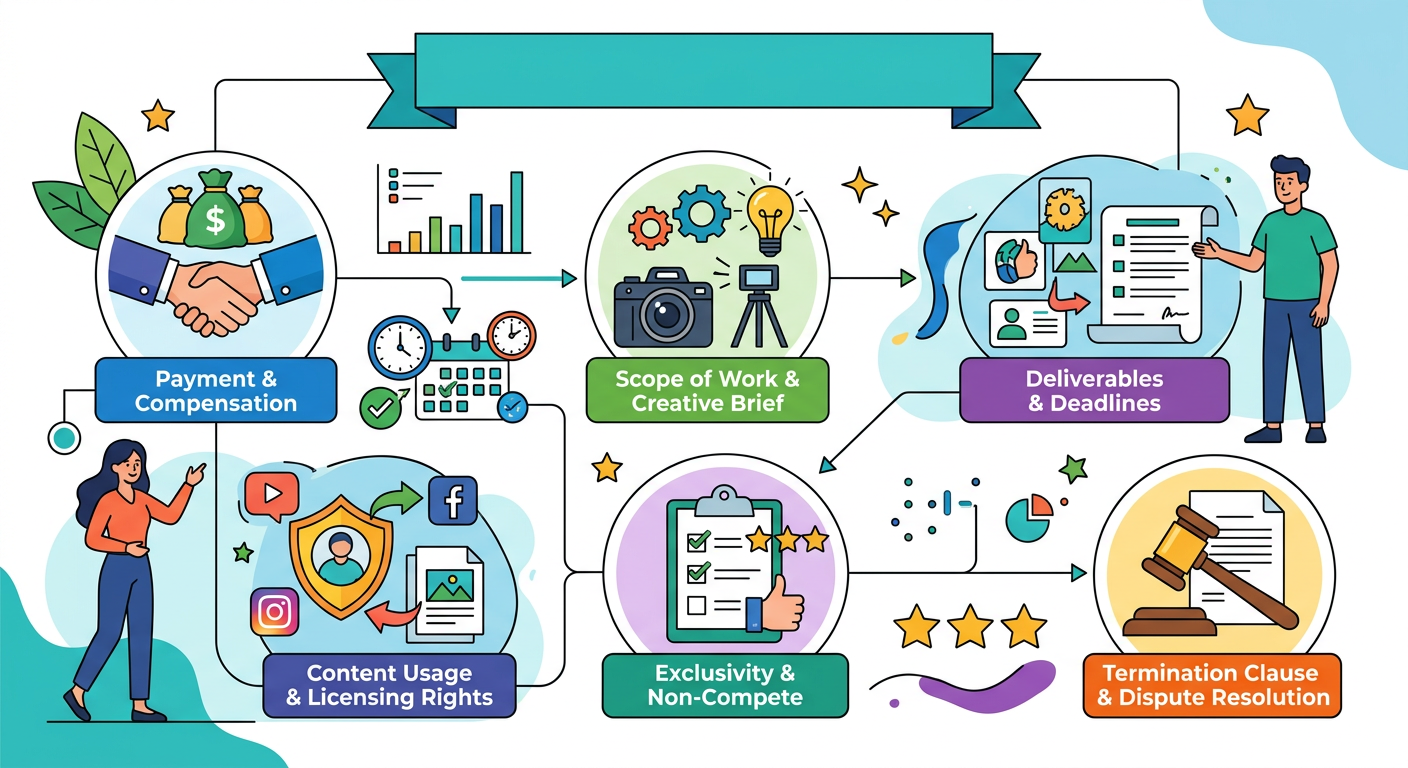
The 8 Clauses Every UGC Creator Contract Must Have
1. Deliverables (Be Specific)
Vague deliverables are where projects fall apart. Don't write "3 videos", write:
- Quantity: 3 vertical videos
- Duration: 15–30 seconds each
- Format: MP4, 1080×1920, no captions burned in
- Style: Authentic unboxing reaction, no scripted voiceover
- Revisions: Up to 2 rounds per video
The more specific, the less argument there is about whether you delivered.
2. Usage Rights (The Most Important Clause)
This is where most creators undercharge and over-give. Define exactly:
- Channels: Paid social only? Organic too? Website? Email?
- Duration: 30 days, 90 days, 6 months, perpetual?
- Geography: US only? Global?
- Exclusivity: Can the brand prevent you from working with competitors?
As a rule: longer duration and broader channels = higher fee. A 90-day paid social license might be $300. A 12-month perpetual license across all channels should be 3–5x that.
3. Payment Terms
Standard practice in the creator economy is 50% upfront, 50% on delivery. Never start work without a deposit.
Include:
- Total fee
- Deposit amount and due date
- Final payment trigger (delivery of finals, or delivery + approval?)
- Payment method (PayPal, bank transfer, etc.)
- Late payment penalty: 1.5% per month is reasonable and enforceable in most jurisdictions
If a brand refuses to pay a deposit, that's a red flag, walk away.
4. Revision Policy
Uncapped revisions are how projects become unprofitable. Define:
- How many rounds are included (2 is standard)
- What counts as a revision vs. a new brief
- Cost for additional revisions (e.g., $50/round after the included limit)
5. Approval and Feedback Timeline
Brands are busy. Without deadlines, feedback takes forever and you're left in limbo. Add:
- Brand has 5 business days to review drafts
- If no feedback is received, content is deemed approved
- Final delivery within 3 business days of approval
6. Creator Credit (Optional but Recommended)
Some creators require on-screen credit or social attribution when content is used organically. This is negotiable, but worth adding if brand awareness matters to you.
7. Content Ownership Until Payment
Until you receive full payment, you retain all rights to the content. This is your nuclear option, it's legally established in most jurisdictions and prevents brands from running your content while disputing invoices.
One sentence does it: "All content remains the intellectual property of [Creator Name] until full payment is received."
8. Termination Clause
What happens if the project gets cancelled mid-way?
- If cancelled before content delivery: creator keeps the deposit
- If cancelled after delivery: creator keeps 100% of payment
- Either party can terminate with 7 days written notice
---
UGC Creator Contract Template Outline
Here's a bare-bones structure you can build from:
SERVICES AGREEMENT
Parties: [Creator Name] ("Creator") and [Brand Name] ("Client")
Date: [Date]
- DELIVERABLES
Specify format, quantity, duration, style
- USAGE RIGHTS
License type: Non-exclusive or Exclusive
Channels: Paid social / Organic / All channels
Duration: 30 / 90 / 180 / 365 days / Perpetual
Territory: US / Global
- FEES AND PAYMENT
Total: $[Amount]
Deposit (50%): $[Amount] due [Date]
Final payment: $[Amount] due upon delivery
Late fee: 1.5% per 30 days
- REVISIONS
Included: 2 rounds
Additional: $[Amount] per round
- FEEDBACK TIMELINE
Client review period: 5 business days
- OWNERSHIP
Content remains Creator property until paid in full.
- TERMINATION
[Cancellation terms]
Signatures: _________________ / _________________
---
What About Platforms That Handle Contracts For You?
If contract negotiation sounds overwhelming, that's partly why platforms like DansUGC exist. When you set up a creator storefront through DansUGC, your packages come with pre-defined deliverables, pricing, and usage terms, so brands know exactly what they're buying before they hit order. No back-and-forth, no missing clauses.
For creators who prefer direct outreach, having your own contract is non-negotiable. For creators who want the deal structure handled, a platform like DansUGC does that heavy lifting automatically.
---
Pricing Usage Rights: A Quick Reference
| License Type | Multiplier on Base Rate |
|---|---|
| 30-day paid social | 1x |
| 90-day paid social | 1.5x |
| 6-month paid social | 2x |
| 12-month all channels | 3–4x |
| Perpetual / unlimited | 5x+ |
These multipliers apply to your base production fee (what it costs you to make the content). A $150 base video with perpetual rights should be priced at $750+.
---
Common Contract Mistakes UGC Creators Make
Starting work without a signed contract. Verbal agreements aren't enforceable in most situations. No signature = no protection.
Not defining "organic" vs. "paid" usage. Organic posts can go viral and effectively act as ads. If a brand wants organic rights, price accordingly.
Granting perpetual rights at flat rates. This is the most expensive mistake. If a brand wants to run your content forever, you should be compensated forever, or charge a premium upfront.
Skipping the revision cap. Two rounds of revisions is industry standard. Without a cap, one demanding client can turn a $300 project into 20 hours of unpaid work.
---
Related Reading
- How to Price Your UGC Packages, establish your base rate before you write any contract
- How to Get Your First Brand Deal as a UGC Creator, where to find the deals you'll be contracting
- UGC Creator Portfolio: What to Include, make sure your portfolio supports your contract rates
---
FAQ
Do UGC creators need a contract?
Yes, every UGC creator working with brands should use a written contract. It defines deliverables, protects your content ownership until payment, limits revisions, and gives you legal recourse if a brand uses your content without paying. Even a simple one-page agreement is significantly better than nothing.
What should a UGC creator contract include?
A UGC creator contract should include: deliverables (format, quantity, duration), usage rights (channels, duration, exclusivity), payment terms (total fee, deposit, due dates, late fees), revision policy (rounds included and cost for extras), a feedback timeline, content ownership clause, and a termination clause.
How much should I charge for usage rights as a UGC creator?
Usage rights pricing depends on channel, duration, and exclusivity. A common framework: 30-day paid social = 1x your base production rate; 90-day = 1.5x; 6-month = 2x; perpetual/unlimited = 5x or more. Organic social rights should be priced separately and often cost as much as paid social.
Should I take a deposit before starting UGC work?
Yes — industry standard is 50% upfront, 50% on delivery. Never start producing content without a deposit. If a brand refuses to pay a deposit, it's a strong signal they may not pay in full either. A deposit also protects your time if the project gets cancelled.
What happens if a brand uses my UGC without a contract?
Without a contract, your legal options are limited but not zero. In most countries, content creators automatically hold copyright over their original work. You can issue a DMCA takedown or cease-and-desist. However, proving agreed payment terms becomes very difficult without written documentation — which is exactly why a contract matters before you deliver anything.
Ready to get UGC videos for your brand?
Real human creators, 48-hour delivery, 12-month commercial license. Starting at $9/video.