UGC Hooks That Stop the Scroll: 15 Real Examples That Convert
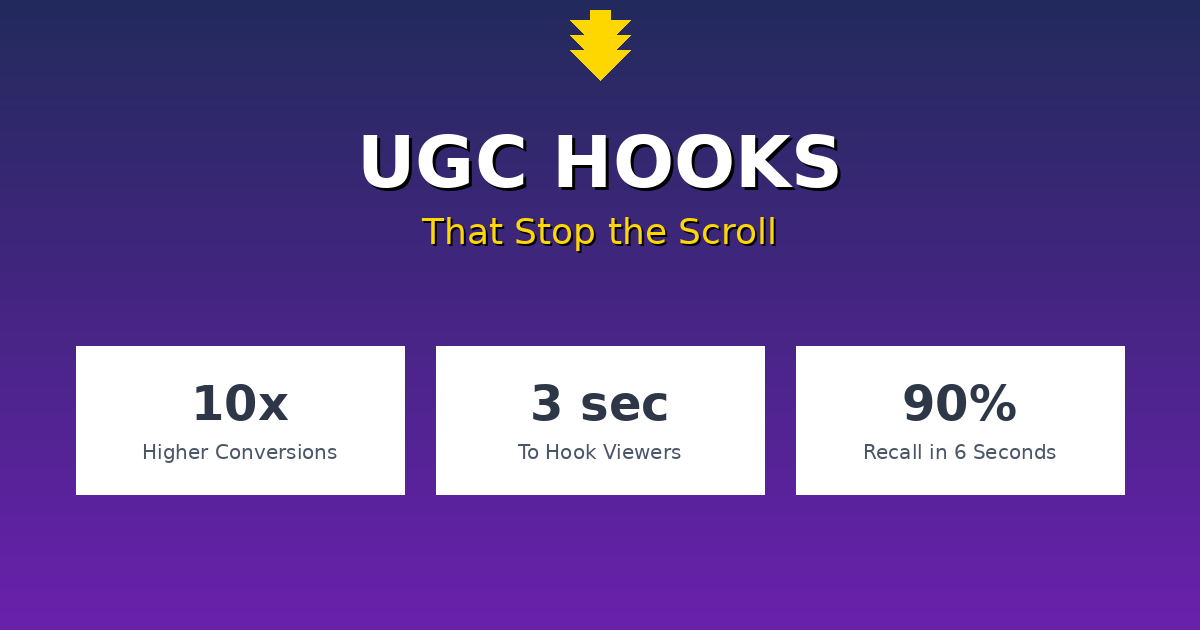
UGC hooks are the make-or-break first 3 seconds of your video content. With 90% of ad recall happening in the first 6 seconds and UGC driving 10x higher conversion rates than non-UGC content, mastering hooks isn't optional anymore. This guide breaks down the 11 highest-performing hook types, from humor and curiosity to pattern interrupts, with real examples that actually convert. You'll learn the 3-part hook formula, see proven scripts you can adapt, and understand why certain hooks outperform others based on platform-specific data from TikTok, Instagram, and Meta ads.

Why Your First 3 Seconds Determine Everything
You have 1.7 seconds. That's how long it takes for a viewer to judge your content and decide whether to keep watching or scroll past. Not 5 seconds. Not "a few moments." Literally less time than it takes to read this sentence.
Here's what that means for your content strategy: if your UGC video doesn't hook viewers immediately, it doesn't matter how good the middle or end is. They'll never see it.
The data backs this up. Ninety percent of brand recall happens in the first six seconds of video content. When you're competing with the height of the Statue of Liberty in daily content consumption, roughly 300 feet worth of scrollable material per user, your hook isn't just important. It's everything.
But here's the good news: UGC with the right hook doesn't just stop scrolls. It converts. Recent benchmark data shows that UGC-focused social posts deliver 10.38x higher conversion rates compared to non-UGC content. That's not a typo. Ten times higher.
The brands winning right now aren't creating more content. They're creating better hooks.
What Actually Makes a Hook Work
A great UGC hook does three things simultaneously: it disrupts the scroll pattern, creates immediate relevance, and triggers emotional engagement.
Think about your own scrolling behavior. What makes you stop? Usually, it's one of three things: something visually unexpected, a statement that speaks directly to your current situation, or content that makes you feel something instantly, whether that's curiosity, relief, excitement, or even mild frustration.
The hook types that consistently outperform fall into six categories: visual, auditory, content-based, emotional, relatable, and curiosity-driven. But the most successful UGC creators don't stick to just one type. They layer them.
Take this example: a creator holds up a product with an unusual camera angle (visual hook) while saying, "I almost returned this until I figured out this one trick" (curiosity hook + relatable setup). That's two hook types working together in the first three seconds.
This layering approach is why some videos get millions of views while similar content gets ignored. It's not luck. It's intentional hook design.
The 11 Hook Types That Actually Convert
1. The Problem Amplification Hook
This hook works by calling out a specific pain point that makes your target audience think, "Wait, that's exactly my problem."
Example scripts:
- "If you're still using [common solution], you're wasting money..."
- "This one mistake is costing you thousands..."
- "Three years ago, I was making this same error every single day..."
These hooks work because they create instant recognition. The viewer sees themselves in the problem, which makes them invested in discovering the solution. For DTC products solving specific problems, this hook type consistently drives the highest intent-to-purchase rates.
The key is specificity. "Tired of acne?" is generic. "If harsh face wash is making your skin worse, not better..." speaks to a specific experience and immediately segments your audience to people actively dealing with that exact frustration.
2. The Curiosity Gap Hook
Curiosity-driven hooks work by withholding the payoff just long enough to keep viewers watching. They create an information gap that the brain naturally wants to close.
Example scripts:
- "You'll never believe what just came in the mail..."
- "I tried [product] for 30 days, here's what nobody tells you..."
- "This changed everything about how I [do specific task]..."
The psychology here is straightforward: humans hate unfinished stories. When you open a loop, viewers stay engaged until you close it. But there's a fine line between curiosity and clickbait. The best curiosity hooks promise something genuinely valuable and then deliver on that promise.
Data shows curiosity hooks perform exceptionally well on TikTok, where the algorithm rewards watch-through rate. If your hook makes people stay to the end, the platform shows your content to more people.
3. The Relatable Moment Hook
These hooks work by depicting a scenario your audience has personally experienced. They're particularly effective for products that solve everyday annoyances.
Example scripts:
- "POV: You're getting ready and realize you're out of [product]..."
- "That moment when you finally admit your [current solution] isn't working..."
- "Me trying to [do task] before I found this..."
Relatable hooks create an immediate emotional connection. When viewers see their own experience reflected back at them, they feel understood. This builds trust before you've even introduced your product.
These hooks work best when you nail the specific details. The more precisely you capture the scenario, the stronger the connection. "Getting ready in the morning" is okay. "That 7 AM panic when you realize you're out of coffee filters" is much better.
4. The Pattern Interrupt Hook
Pattern interrupts work by breaking the visual or auditory expectations viewers have when scrolling. They literally disrupt the pattern recognition in the brain.
Example scripts:
- [Sudden movement or action in frame]
- [Unexpected camera angle or perspective]
- [Contrasting visual elements or rapid cuts]
These don't necessarily need words. A hand reaching into frame, an unusual POV shot, a quick zoom, anything that looks different from the 50 other videos surrounding yours creates that crucial pause in scrolling.
Unusual camera angles remain one of the most effective pattern interrupts. Shooting from above, below, or through something creates visual curiosity that text-based hooks can't replicate. Pair this visual disruption with a strong verbal hook, and you've got a double punch that's hard to ignore.
5. The Social Proof Hook
These hooks leverage the psychological principle that people look to others when making decisions. They work particularly well for products where validation matters.
Example scripts:
- "After seeing this all over my FYP, I finally tried it..."
- "Everyone in my comments asked about this, so here's the truth..."
- "Why is everyone suddenly using [product]? I investigated..."
Social proof hooks tap into FOMO and herd mentality. When viewers see that others are already interested, engaged, or buying, they want to know why. This hook type has seen a significant rise in effectiveness as users become more skeptical of traditional advertising.
The key is authenticity. Genuine curiosity about why something is popular resonates. Forced enthusiasm about a trend doesn't. The best social proof hooks feel like the creator is investigating something they're genuinely curious about, not selling something.
6. The Transformation Hook
Transformation hooks show or promise a before/after change. They work because humans are wired to notice change and improvement.
Example scripts:
- "30 days ago, my skin looked completely different..."
- "This is what happened when I switched from [X] to [Y]..."
- "Before vs. after using this for one month..."
These hooks create immediate visual interest and promise valuable information. The viewer wants to know what changed and how they can replicate it. Time-based transformations ("7 days," "one month," "this morning vs. tonight") work particularly well because they create concrete expectations.
Data from beauty, fitness, and lifestyle brands shows transformation hooks drive the highest save rates. When people see results, they bookmark the content to revisit or share. Those saves signal quality to platform algorithms, extending your reach.
7. The Educational Promise Hook
These hooks work by promising to teach something specific and immediately valuable. They position the creator as helpful rather than salesy.
Example scripts:
- "Three things I wish I knew before buying..."
- "Here's what they don't tell you about [product category]..."
- "The science behind why [product] actually works..."
Educational hooks lower resistance because they're informational rather than promotional. Viewers feel like they're learning, not being sold to. This is particularly effective when your product requires some explanation or when competing products have failed your audience in the past.
The specificity matters here too. "5 tips for better skin" is forgettable. "The exact order to apply skincare products if you have sensitive skin" promises specific, actionable information that a particular segment of viewers desperately needs.
8. The Contrarian Hook
Contrarian hooks challenge common beliefs or popular solutions. They work by creating tension between what viewers think they know and what you're about to reveal.
Example scripts:
- "Everyone's doing [popular thing] wrong, here's why..."
- "Stop using [common solution]. This is better..."
- "Unpopular opinion: [controversial but defensible take]..."
These hooks generate engagement because they're inherently debate-worthy. Even if viewers initially disagree, curiosity about why someone would make a contrarian claim keeps them watching. The key is backing up your contrarian stance with evidence or results, not just hot takes.
Be careful with these. False contrarianism for attention damages trust. But genuine contrarian insights, things you've learned through experience that go against conventional wisdom, can position you as a thought leader and drive significant engagement.
9. The Storytelling Hook
Story-based hooks work by starting a narrative that viewers want to see completed. They create investment in what happens next.
Example scripts:
- "This is the story of how I accidentally discovered..."
- "Two months ago, something happened that changed everything..."
- "Let me tell you about the worst purchase I ever made (and how I fixed it)..."
Human brains are hardwired for stories. We remember narratives better than facts, and we're naturally drawn to story structures with setups and payoffs. These hooks work across all demographics because storytelling transcends age, platform, and product category.
The most effective story hooks establish stakes immediately. The viewer needs to understand why this story matters to them within those first few seconds. "Let me tell you a story" is weak. "The worst financial mistake I made cost me $3,000, here's how you can avoid it" immediately establishes relevance and stakes.
10. The Humor Hook
Funny hooks work by creating positive emotion and lowering defenses. When people laugh, they're more receptive to what comes next.
Example scripts:
- [Relatable exaggeration of a common frustration]
- [Self-deprecating humor about a mistake]
- [Unexpected comparison or observation]
Humor is tricky because it's subjective, but when it lands, it creates some of the highest engagement rates and shareability. The key is aligning your humor with your brand voice and ensuring the joke doesn't overshadow your message.
Gen Z audiences respond particularly well to humor hooks on TikTok, where authentic, self-aware content outperforms polished ads. The humor doesn't need to be comedy-special quality. Relatable observations delivered with good timing work just as well.
11. The Direct Result Hook
These hooks cut straight to the benefit or outcome. They work for audiences who are already problem-aware and shopping for solutions.
Example scripts:
- "This cleared my acne in two weeks..."
- "I saved $500 this month by switching to..."
- "My skin has never looked better, and here's exactly what I used..."
Direct result hooks are less about creativity and more about clarity. They work best lower in the funnel when viewers already know they need a solution and are comparing options. These hooks pair exceptionally well with strong visuals that show the result immediately.
For retargeting campaigns and warmer audiences, direct result hooks often outperform more creative approaches. If someone has visited your product page or watched previous content, they don't need a clever hook; they need proof that your product delivers.
The Hook Formula That Works Every Time
While the 11 hook types above give you frameworks to work with, there's a simple three-part formula that works across almost every successful UGC hook:
Part 1: The Attention Grabber (0-1 second)
This is your pattern interrupt. Whether it's movement, a bold statement, an unusual visual, or a specific call-out, this first element must create that crucial pause in scrolling.
Part 2: The Relevance Bridge (1-2 seconds)
This is where you connect the attention you just grabbed to your viewer's actual life or problem. You're answering the implicit question: "Why should I keep watching this?"
Part 3: The Value Promise (2-3 seconds)
This is where you explicitly or implicitly promise that continuing to watch delivers something valuable, a solution, information, entertainment, or transformation.
Here's the formula in action:
Attention Grabber: [holding product + unusual angle]
Relevance Bridge: "If you're still spending $30 on face wash..."
Value Promise: "...this $12 alternative changed everything."
All three components delivered in under three seconds, working together to stop the scroll and create a reason to keep watching.
Platform-Specific Hook Strategies
Different platforms reward different hook styles. What works on TikTok might fall flat on Facebook. Here's what the data shows:
TikTok favors fast-paced, audio-driven hooks that tap into trends or sound bites. The platform's younger demographic responds well to humor, relatable moments, and pattern interrupts. Start with movement or unexpected visuals, and consider trending audio.
Instagram Reels performs best with strong visual hooks and text overlays. The sound-off viewing behavior means your hook needs to work visually. Transformation hooks and before/after content excel here. Use on-screen text strategically to reinforce your hook.
Facebook/Meta Ads convert best with direct, problem-solution hooks that speak to specific pain points. This audience tends to be older and more skeptical, so education-based and social proof hooks outperform entertainment-focused content.
YouTube Shorts reward educational and storytelling hooks. The platform's watch-time algorithm means hooks that promise valuable information or compelling narratives perform better than quick-hit entertainment.
Testing and Optimizing Your Hooks
Here's what most brands get wrong about hooks: they create one, hope it works, and move on. The brands seeing 10x conversion rates? They're testing hooks systematically.
Start by creating 3-5 different hook variations for the same core message. Test them with real ad spend or organic posting schedules. Track not just views, but watch-through rate, click-through rate, and conversion rate.
Pay attention to your three-second drop-off rate. If more than 60% of viewers leave before three seconds, your hook isn't working. If watch time drops significantly after the first ten seconds, your hook might be working too well, it's creating expectations your content doesn't fulfill.
The fastest way to improve your hooks is watching successful content in your niche and breaking down their hook structure. What did they do in the first three seconds? How did they create relevance? What was the payoff?
Common Hook Mistakes That Kill Conversions
Even with the right formula, most brands make these critical mistakes:
Mistake #1: Starting with a greeting. "Hey guys, it's Sarah here" wastes your most valuable seconds. Nobody cares who you are in the first three seconds. They care about what's in it for them.
Mistake #2: Being too vague. Generic hooks like "check this out" or "you need to see this" create zero specificity or relevance. Your hook should speak to a specific person with a specific problem or interest.
Mistake #3: Burying the hook. Your most compelling element should be first, not third. Front-load your best material. Viewers won't wait for you to get to the good part.
Mistake #4: Overpromising. Creating curiosity is good. Creating expectations you can't meet destroys trust. If your hook promises a revolutionary solution, your content better deliver one.
Mistake #5: Ignoring sound-off viewing. Over 85% of social video is watched without sound initially. If your hook requires audio to make sense, you're losing most of your potential viewers.
The Real Numbers: Why This Matters
Let's talk about the business impact of getting hooks right.
UGC-based ads achieve 4x higher click-through rates and 50% reduction in cost-per-click compared to traditional ads. That's not incremental improvement. That's transformational.
Brands using UGC see 29% higher web conversion rates. When visitors interact with UGC, they convert at rates 102% higher than the site average. And featuring UGC increases revenue per visitor by 154%.
But here's the really interesting part: the UGC market itself grew from $4.5 billion in 2024 to over $7.6 billion in 2025, a 69% increase in a single year. By 2029, experts project it will exceed $27 billion.
Why? Because it works. And more specifically, because UGC with strong hooks works at a scale and cost-efficiency that traditional advertising simply can't match.
Bringing It All Together
The difference between a video that gets scrolled past and one that converts comes down to those first three seconds. Your hook isn't just an introduction; it's the entire reason someone decides to engage with your content at all.
The brands winning right now aren't necessarily the ones with the biggest budgets or the most polished production. They're the ones who understand that attention is the new currency, and hooks are how you earn it.
Start with the 11 hook types outlined here. Use the three-part formula to structure your openings. Test systematically. And most importantly, remember that the goal of a hook isn't to be clever or creative for its own sake; it's to create immediate relevance for your specific audience.
Because in a world where people scroll through 300 feet of content daily, being relevant in those first three seconds isn't just important. It's the only thing that matters.
Ready to Level Up Your UGC Game?
Creating scroll-stopping UGC hooks is both an art and a science. The frameworks and examples in this guide give you the science, the proven patterns that work. The art comes from understanding your specific audience and testing what resonates with them.
Start by auditing your existing content. Which videos have the highest watch-through rates? What hooks are those videos using? Then, systematically test new hook types from this guide against your current best performers.
Remember: the goal isn't to be entertaining or clever. The goal is to stop the scroll by creating immediate, undeniable relevance to your viewer. Do that, and conversions follow.
The brands dominating UGC right now aren't lucky. They're strategic. They understand that every second of viewer attention must be earned, and they've mastered the hooks that do exactly that.
Now it's your turn.
Ready to get UGC videos for your brand?
Real human creators, 48-hour delivery, full commercial rights. Starting at $9/video.