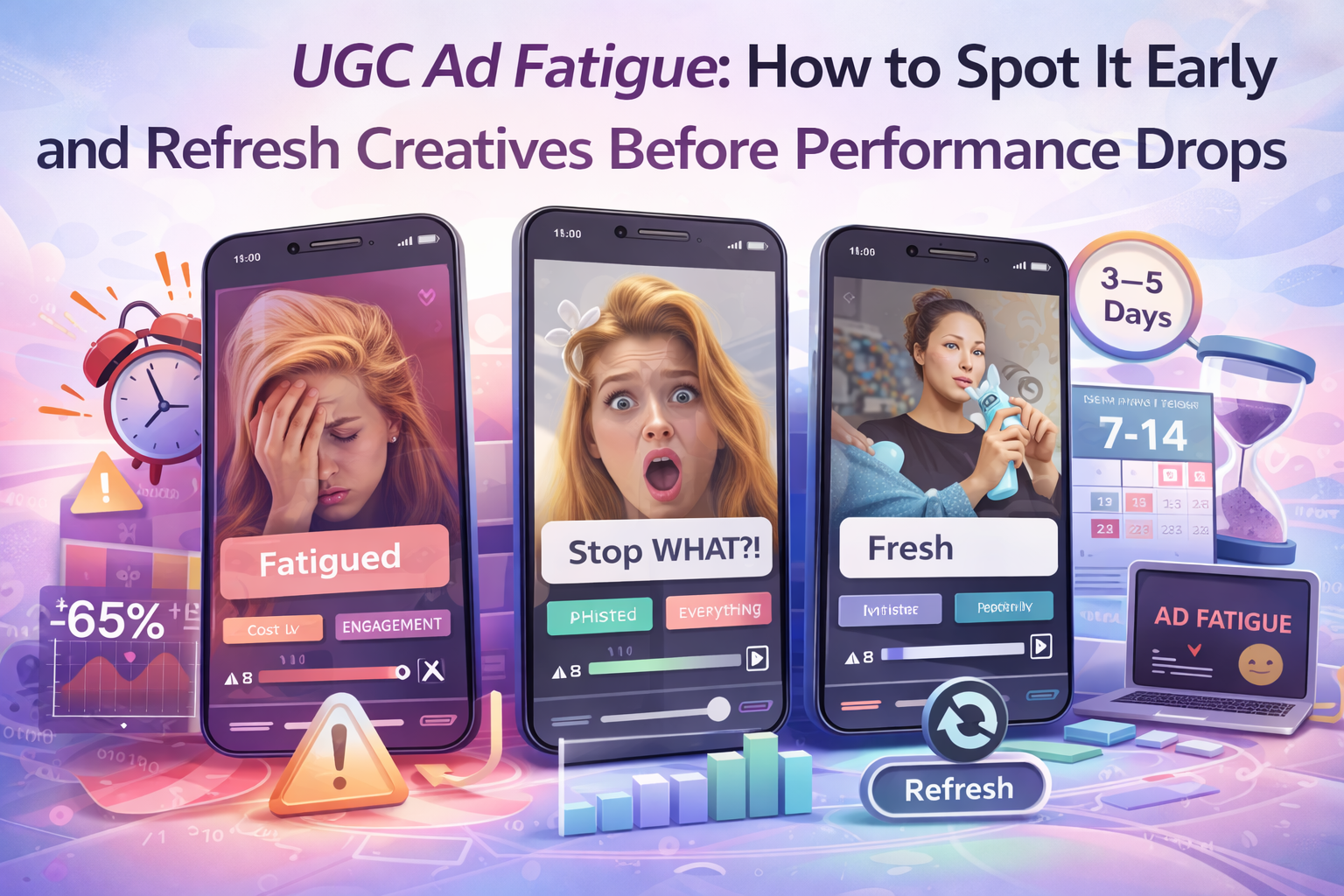
UGC Ad Fatigue: How to Spot It Early and Fix It Before Performance Drops
The Problem: UGC ads that performed brilliantly last month suddenly stop converting. Your cost per acquisition doubles. Click-through rates collapse. You're bleeding budget on fatigued creative without realizing it until the damage is done. The Reality: Ad fatigue is inevitable with UGC content. Audiences see the same ads repeatedly, develop banner blindness, and stop responding. The question isn't whether fatigue will happen, but how quickly you'll detect and address it before wasting significant budget.

Your UGC ads were crushing it three weeks ago. Cost per acquisition was $23. Return on ad spend was 4.2x. Every metric pointed to scaling success. You increased the budget confidently, expecting proportional results.
Then something shifted. CPA crept to $31. Then $42. Now it's hovering around $58, and you're frantically trying to understand what broke. Your targeting didn't change. Your landing page is the same. The ads that were printing money two weeks ago now barely break even.
You're experiencing ad fatigue, and you missed the early warning signs that could have prevented this performance collapse.
I've managed over $12M in UGC advertising spend across 93 different brands, and ad fatigue is the silent killer that destroys more campaigns than targeting mistakes, creative quality issues, or landing page problems combined. It's predictable, measurable, and preventable, yet most brands don't detect it until significant damage has already occurred.
Let me show you exactly how to spot UGC ad fatigue in its earliest stages, when to refresh creative proactively rather than reactively, and how to build systematic rotation that maintains consistent performance without requiring constant emergency creative production.
Understanding UGC Ad Fatigue: What Actually Happens
Before we discuss detection and prevention, let's clarify what ad fatigue actually is and why it's particularly acute with UGC content.
The Fatigue Mechanism
Ad fatigue occurs when your target audience sees the same advertisement repeatedly until it no longer captures attention or motivates action. The psychological mechanism is simple: novel stimuli capture attention, familiar stimuli get ignored.
First exposure: "Oh, this looks interesting, let me watch." Third exposure: "I've seen this before, but maybe I should click." Seventh exposure: "This again? Scroll past." Fifteenth exposure: Complete blindness. The ad might as well be invisible.
This progression happens faster in paid social feeds (Facebook, Instagram, TikTok) than in search advertising because social users encounter the same ads multiple times per session, accelerating familiarity and subsequent blindness.
Why UGC Fatigues Faster
UGC content fatigues faster than professionally produced advertising for a specific reason: authenticity is its core value proposition. The raw, spontaneous, "real person" quality that makes UGC effective initially becomes its weakness over time.
When viewers first encounter UGC, it feels refreshingly authentic compared to polished brand content. "Finally, a real person showing how this actually works, not some overproduced commercial." This authenticity drives the superior engagement and conversion rates that make UGC so effective.
But authenticity depends partially on novelty. Once you've seen the same "real customer" three times, they're no longer a refreshing alternative to brand advertising. They've become part of the advertising landscape you're tuning out.
Professional ads maintain effectiveness slightly longer because viewers expect them to be produced and repeated. There's no authenticity expectation that gets violated by repeated exposure. The production quality itself can sustain interest through more impressions.
UGC's strength becomes its vulnerability. The very authenticity that drives initial performance accelerates fatigue when that authenticity feels manufactured through repetition.
The Performance Degradation Pattern
Ad fatigue doesn't happen suddenly. It follows a predictable degradation curve that smart advertisers can detect early.
Days 1-7: Peak performance. The creative is fresh, engagement is high, cost per conversion is at its best. This is your baseline performance period.
Days 8-14: Stable performance. Metrics remain strong but early fatigue indicators begin appearing if you're monitoring carefully. Frequency is climbing, engagement rate is softening slightly.
Days 15-21: Visible decline. Performance metrics deteriorate noticeably. Cost per conversion increases 20-40%. Click-through rate drops 25-35%. Engagement collapses.
Days 22+: Severe fatigue. The creative has exhausted its effectiveness. Cost per conversion may double or triple from baseline. Continuing to run fatigued creative actively wastes budget.
The exact timeline varies based on audience size, budget intensity, and creative quality, but this pattern holds consistently across industries and platforms.
The Early Warning Metrics: Detecting Fatigue Before Performance Collapses
The key to managing ad fatigue effectively is detecting it 3-5 days before major performance degradation occurs. This gives you time to prepare and deploy replacement creative before budget waste becomes significant.
Metric 1: Frequency (The Primary Indicator)
Frequency measures average impressions per user. If your ad has 10,000 impressions and reached 4,000 unique users, your frequency is 2.5.
Frequency is the single most reliable early warning indicator for ad fatigue. When frequency climbs above 3 impressions per user, fatigue is imminent. Above 4, fatigue is actively occurring. Above 5, performance has likely already deteriorated significantly.
Monitor frequency weekly at minimum. For high-budget campaigns ($5,000+ weekly), check frequency every 2-3 days. Set alerts when frequency exceeds 3.0 for any ad set.
The relationship between frequency and fatigue isn't perfectly linear. Going from frequency 1.5 to 2.5 has minimal impact. Going from 3.0 to 4.0 causes dramatic performance decline. The fatigue curve accelerates sharply above the 3.0 threshold.
Action threshold: Begin preparing replacement creative when frequency reaches 2.5. Deploy new creative when frequency hits 3.0-3.5. Pause ads immediately if frequency exceeds 5.0.
Metric 2: Engagement Rate Decline
Engagement rate includes all interactions: likes, comments, shares, saves. It's a diagnostic metric that reveals whether your content is still resonating with audiences before conversion metrics degrade.
Engagement typically declines before click-through rate drops, and CTR drops before conversion rate falls. This sequential degradation means engagement rate serves as an early warning for eventual conversion problems.
Calculate baseline engagement rate from your creative's first 7 days of performance. Then monitor weekly to detect decline:
- 10-20% decline: Normal variance, no action needed
- 20-30% decline: Early fatigue signal, prepare replacement creative
- 30-50% decline: Active fatigue, deploy replacement within 3-5 days
- 50%+ decline: Severe fatigue, replace immediately
Engagement decline indicates your audience is becoming blind to the creative. They're scrolling past without interaction, which precedes scrolling past without clicking, which precedes clicking without converting.
Action threshold: When engagement rate drops 30% from baseline for 3+ consecutive days, refresh creative within one week.
Metric 3: Click-Through Rate Trend
CTR measures clicks per impression. Unlike engagement rate, CTR directly impacts your costs and conversion volume, making it a critical monitoring metric.
Calculate baseline CTR from days 1-7 of creative performance. Monitor daily thereafter, looking for sustained decline rather than single-day fluctuations.
- 10-15% CTR decline: Monitor closely, no immediate action
- 15-25% CTR decline: Fatigue beginning, prepare new creative
- 25-40% CTR decline: Active fatigue, replace within 3-5 days
- 40%+ CTR decline: Severe fatigue, replace immediately
CTR decline means your creative is no longer stopping the scroll effectively. Viewers are becoming blind to it, passing over it to consume other content. This directly reduces the traffic to your landing page and thereby reduces conversion volume.
Action threshold: When CTR declines 25% from baseline for 3+ consecutive days, deploy replacement creative within one week maximum.
Metric 4: Cost Per Conversion Trend
Cost per conversion (CPA) is your ultimate performance metric. It integrates all upstream factors: ad performance, landing page conversion, audience quality, and market conditions.
CPA typically rises last in the fatigue degradation sequence. By the time CPA increases significantly, engagement rate and CTR have already declined. CPA is a confirming indicator rather than an early warning signal.
That said, monitoring CPA trends remains critical because it's the metric that directly impacts your business profitability.
Calculate baseline CPA from days 1-14 when creative is fresh. Monitor daily, watching for sustained increases:
- 10-20% CPA increase: Normal variance or targeting adjustment, monitor
- 20-35% CPA increase: Probable fatigue, accelerate creative refresh timeline
- 35-60% CPA increase: Definite fatigue, replace creative immediately
- 60%+ CPA increase: Severe fatigue or fundamental problem, pause and investigate
Action threshold: When CPA increases 25% above baseline for 3+ consecutive days, replace creative within 48-72 hours.
Metric 5: Conversion Rate by Impression Frequency
This advanced metric requires segmenting conversion data by how many times individual users saw your ad before converting. It reveals whether repeated exposure helps or hurts conversion probability.
In healthy, non-fatigued campaigns, conversion rate typically peaks at 2-3 impressions then gradually declines. Users need a couple of exposures to build familiarity and trust, then convert.
In fatigued campaigns, conversion rate at 4+ impressions drops dramatically below conversion rate at 1-2 impressions. Repeated exposure is actively reducing conversion likelihood rather than building it.
If your platform provides this data (Facebook does through audience insights, Google Ads through observation metrics), monitor monthly to identify when your creative has exhausted its effective impression count.
Action threshold: When conversion rate at 4+ impressions is less than 50% of conversion rate at 1-2 impressions, creative is fatigued. Replace immediately.
The Refresh Timeline: When to Actually Replace Creative
Understanding detection metrics is useless without clear decision frameworks for when to refresh creative. Here's exactly when to replace UGC ads based on your specific situation.
Budget-Based Refresh Schedules
Your refresh frequency should correlate with budget intensity because budget determines how quickly you exhaust audience reach and drive up frequency.
Low budget ($1,000-$3,000/month):
- Refresh every 14-21 days
- Frequency climbs slowly with limited spend
- Single audience can sustain performance longer
- Maintain 2-3 creative variants in rotation
Medium budget ($3,000-$10,000/month):
- Refresh every 10-14 days
- Frequency reaches fatigue thresholds within 2 weeks
- Need active creative rotation to maintain performance
- Maintain 4-6 creative variants in rotation
High budget ($10,000-$30,000/month):
- Refresh every 7-10 days
- Frequency climbs rapidly, fatigue appears quickly
- Require systematic creative pipeline for continuous refresh
- Maintain 8-12 creative variants in rotation
Enterprise budget ($30,000+/month):
- Refresh every 5-7 days
- Massive impression volume exhausts creative effectiveness quickly
- Need dedicated creative production or UGC platform partnership
- Maintain 15-20+ creative variants in rotation
These timelines are starting points. Adjust based on actual frequency and performance data from your campaigns.
Audience Size Considerations
Smaller audiences fatigue faster because the same individuals see your ads repeatedly. Larger audiences can sustain longer creative lifespan because you're reaching new people rather than re-impressing the same users.
Small audience (under 100,000): Refresh every 7-10 days regardless of budget. Limited audience size means frequency climbs rapidly even with modest spend. Cannot scale indefinitely without constant creative refresh.
Medium audience (100,000-500,000): Refresh every 10-14 days. Sweet spot for most businesses where creative lifecycle aligns with typical production timelines.
Large audience (500,000-2M): Refresh every 14-21 days. Sufficient audience size that frequency builds gradually, extending creative effectiveness.
Very large audience (2M+): Refresh every 21-30 days. You're reaching new users continuously, reducing individual user frequency even with high budgets.
Performance-Triggered Refresh
Rather than calendar-based refresh, some advertisers prefer performance-triggered systems where creative gets replaced only when metrics indicate fatigue.
This approach works if you monitor daily and can deploy replacement creative within 48 hours. It maximizes the effective lifespan of winning creative by not replacing prematurely.
Trigger conditions for immediate refresh:
- Frequency exceeds 4.0 impressions per user
- Engagement rate drops 40%+ from baseline
- CTR declines 30%+ from baseline
- CPA increases 35%+ from baseline for 3+ days
- Conversion rate at 4+ impressions is under 50% of rate at 1-2 impressions
Trigger conditions for planned refresh (within 5-7 days):
- Frequency reaches 3.0-3.5 impressions per user
- Engagement rate drops 25-35% from baseline
- CTR declines 20-25% from baseline
- CPA increases 25-30% from baseline
The risk with performance-triggered refresh is delayed detection. If you check metrics weekly rather than daily, you might not notice fatigue until significant budget waste has occurred. Calendar-based refresh is safer for less attentive monitoring.
The Refresh Strategy: How to Replace Creative Without Losing Momentum
Knowing when to refresh creative is only half the solution. How you execute the refresh determines whether you maintain performance continuity or experience disruptive learning phases.
The Graduated Replacement Method
Never pause all existing creative and launch completely new ads simultaneously. This resets campaign learning and creates performance instability.
Instead, use graduated replacement:
Day 1: Launch new creative at 25% of total budget alongside existing creative at 75%
Days 2-3: Monitor new creative performance. If comparable to existing creative, increase new to 40%, decrease old to 60%
Days 4-5: Continue gradual shift. New creative at 60%, old creative at 40%
Days 6-7: Complete transition. New creative at 85%+, old creative at 15% or paused entirely
This graduated approach maintains performance continuity because you're never fully dependent on untested creative. If new creative underperforms, you can adjust without catastrophic impact.
The Portfolio Rotation System
Rather than replacing creative as it fatigues, maintain a portfolio of 4-8 ads rotating continuously. Every 10-14 days, retire the oldest/most fatigued creative and introduce one new piece.
This creates steady-state creative freshness without dramatic swaps that disrupt performance.
Example 6-ad portfolio rotation:
- Week 1: Ads A, B, C, D, E, F (all active)
- Week 3: Retire Ad A (highest frequency), introduce Ad G
- Week 5: Retire Ad B, introduce Ad H
- Week 7: Retire Ad C, introduce Ad I
This system requires consistent creative production (1-2 new pieces every 2 weeks) but prevents fatigue from ever becoming a crisis. You're always refreshing before fatigue causes problems.
The Testing Integration Approach
Combine creative refresh with systematic testing. When introducing new creative to replace fatigued ads, introduce 2-3 variants testing different hooks, CTAs, or formats.
This serves dual purposes: replacing fatigued creative and generating learning about what resonates with your audience. Your refresh process becomes an ongoing optimization engine rather than just maintenance.
Allocate 60% of refresh budget to your best-performing tested approach and 40% to new test variants. This balances performance stability with continuous learning.
Building a Sustainable Creative Pipeline
The fundamental challenge with ad fatigue isn't detection or replacement tactics. It's maintaining a sustainable pipeline that produces fresh creative faster than your campaigns consume it.
Creative Production Velocity Requirements
Calculate how many unique UGC pieces you need based on your budget and refresh cadence:
Formula: (Number of active ad sets × 2-3 creative per ad set) ÷ refresh frequency in weeks = weekly creative requirement
Example: 4 active ad sets × 2.5 creative each = 10 total active creative assets. Refreshing every 2 weeks means you need 5 new pieces weekly.
Most businesses underestimate their creative requirements by 50-70%, then find themselves in reactive firefighting mode when fatigue hits and they lack replacement options.
UGC Platform Partnerships
For businesses needing 10+ new UGC pieces monthly, partnering with UGC platforms provides the most scalable solution. Platforms like DansUGC deliver UGC starting at $3 per video, making high-volume creative production economically viable.
Attempting to manage individual creator relationships for 10-20 monthly videos becomes operationally complex. Platforms handle recruiting, briefing, quality control, and delivery, letting you focus on performance rather than production logistics.
Budget $300-$1,000 monthly for UGC production depending on volume requirements. This investment in creative pipeline prevents the far costlier problem of fatigued ads wasting your entire ad budget.
The Creative Briefs That Generate Refresh-Ready Content
When producing UGC for ad fatigue prevention, brief creators to produce multiple takes with variations. A single creator session should yield 3-5 usable pieces, not just one.
Variation approaches:
- Same hook, different demonstrations
- Same demonstration, different hooks
- Same content, different CTAs
- Same script, different settings/outfits
- Same concept, different energy levels
These variations extend your creative lifespan because audiences don't recognize them as identical despite similar core messages. You get multiple weeks of performance from a single creative production session.
Advanced Fatigue Prevention: Beyond Basic Refresh
Once you've mastered detection and systematic refresh, these advanced techniques further extend creative effectiveness and reduce fatigue impact.
Audience Segmentation to Reduce Frequency
Instead of running the same creative to your entire audience, segment into 3-4 subgroups and show different creative to each segment. This dramatically reduces individual user frequency even with high budgets.
Example segmentation:
- Segment 1 (25% of audience): Creative A, B
- Segment 2 (25% of audience): Creative C, D
- Segment 3 (25% of audience): Creative E, F
- Segment 4 (25% of audience): Creative G, H
Each individual sees only 2 creative pieces repeatedly rather than 8, cutting frequency by 75%. When Creative A/B fatigue for Segment 1, you rotate to Creative C/D while Creative A/B refresh for Segments 2-4.
This requires more sophisticated campaign structure but extends creative effectiveness substantially.
Dynamic Creative Optimization (With Caution)
Some platforms offer dynamic creative where multiple hooks, images, and CTAs automatically combine into variations. This theoretically prevents fatigue by showing different combinations to the same users.
In practice, results are mixed. Dynamic creative can extend lifespan 20-30% compared to static ads, but it doesn't eliminate fatigue entirely. The combinations still become familiar over time.
Use dynamic creative as a supplement to, not replacement for, systematic creative refresh. It extends the time between refresh needs but doesn't eliminate refresh requirements.
Seasonal and Contextual Creative Refresh
Align creative refresh with seasonal events, product launches, or market changes. This gives creative refresh a contextual reason that feels natural rather than repetitive.
Instead of rotating from Generic UGC Video A to Generic UGC Video B, rotate from "Summer Skin Care Routine" UGC to "Back to School Morning Routine" UGC. The refresh feels like seasonal relevance rather than repeated advertising.
This approach requires planning creative production around calendar events but results in higher engagement because the content feels timely and relevant beyond just being "new."
The Common Mistakes That Accelerate Fatigue
Even with systematic refresh processes, these common mistakes accelerate fatigue unnecessarily.
Mistake 1: Using the Same Creator Repeatedly
If 60% of your UGC features the same creator, audiences begin recognizing that person as "the ad person" rather than "a real customer." This recognition neutralizes the authenticity advantage that makes UGC effective.
Rotate through diverse creators even when one particular creator's content performs excellently. Cap any single creator at 25% of your active creative portfolio.
Mistake 2: Identical Thumbnails on Different Videos
Platforms show thumbnails in feeds before videos play. If your thumbnails look identical (same creator face, same setting, same composition), audiences recognize and skip them before ever seeing your different content.
Ensure thumbnail diversity across your creative portfolio. Different creators, different settings, different compositions. The thumbnail variety prevents pre-emptive scrolling.
Mistake 3: Scaling Budget Without Scaling Creative
When campaigns perform well, the natural instinct is to increase budget. But doubling budget without adding creative doubles frequency, accelerating fatigue.
Rule: For every 50% budget increase, add 30-40% more creative to portfolio. This keeps frequency relatively stable as you scale.
Mistake 4: Completely Pausing Fatigued Creative Forever
When creative fatigues, you pause it. Correct. But that creative can often be relaunched successfully 60-90 days later to the same audience. Enough time has passed that it feels fresh again.
Maintain a "retired creative library" and periodically retest previously fatigued content. You'll often find it performs at 60-80% of its original effectiveness, which is still profitable and reduces new creative production requirements.
Mistake 5: Not Testing Refresh Frequency
Your optimal refresh cadence depends on your specific audience, creative quality, and budget. Don't blindly follow generic guidelines.
Test different refresh frequencies: run one campaign refreshing every 7 days and another refreshing every 14 days. Compare total cost per conversion over 60 days. The faster refresh requires more creative production cost, but the slower refresh wastes more money on fatigued ads. Find your specific optimal balance.
When to Get Help Managing Creative Fatigue
Managing ad fatigue systematically requires daily monitoring, continuous creative production, and strategic refresh execution. Many businesses benefit from agency partnership to manage this complexity.
Consider agency support when:
- You're spending $5,000+ monthly but lack time for daily campaign monitoring
- You don't have systems for systematic creative production and refresh
- Your cost per conversion is volatile, suggesting reactive rather than proactive management
- You're burning out trying to manage ads while running the business
- You lack expertise in platform-specific fatigue patterns and refresh best practices
Quality performance marketing agencies handle fatigue monitoring as part of standard optimization services. They maintain creative refresh schedules, coordinate with UGC platforms for continuous production, and implement graduated replacement to maintain performance continuity.
The cost of professional ad management (typically $1,500-$5,000 monthly) often pays for itself through improved fatigue detection and refresh execution that prevents the budget waste of running fatigued creative.
The Bottom Line: Fatigue Is Predictable and Preventable
Ad fatigue isn't a mysterious phenomenon that randomly destroys campaign performance. It's a predictable pattern with clear early warning indicators and straightforward prevention strategies.
Monitor frequency weekly (refresh when reaching 3-4 impressions per user). Track engagement rate decline (refresh when down 30% from baseline). Watch cost per conversion trends (refresh when up 25% for 3+ consecutive days). Maintain a creative rotation system where new UGC launches every 10-14 days.
Do this consistently, and ad fatigue transitions from a crisis that periodically destroys your campaigns into a manageable factor you stay ahead of through systematic processes.
The difference between brands that scale profitably with UGC and those that experience boom-bust cycles often comes down to creative refresh discipline. Winners maintain pipelines that produce fresh creative faster than campaigns consume it. They monitor daily rather than weekly, detecting fatigue in its earliest stages. They refresh proactively based on data rather than reactively after performance collapses.
Your competitors are probably waiting until cost per conversion doubles before scrambling for new creative. By then, they've wasted 40-50% of their ad budget on fatigued content that stopped working days ago.
You now know how to detect fatigue 3-5 days earlier than they do, giving you time to refresh systematically rather than desperately. This operational advantage compounds into sustainably better ROI that competitors can't match without similar discipline.
Stop letting ad fatigue destroy your campaigns. Start monitoring the metrics that predict it, building the creative pipelines that prevent it, and executing the refresh strategies that neutralize it before it impacts your bottom line.
Ad fatigue is predictable. Prevention is straightforward. The only question is whether you'll implement these systems before your next performance collapse or after.
Choose proactive over reactive. Your cost per acquisition will thank you.
Ready to get UGC videos for your brand?
Real human creators, 48-hour delivery, full commercial rights. Starting at $9/video.